Calculator
Keg Carbonation Calculator
Set it, leave the gas connected, and the beer reaches equilibrium and stays there.
This is a regression fitted to the published CO2 solubility tables, so it is only meaningful across ordinary serving temperatures and it is not extrapolated beyond them here. At the pressure it returns, the CO2 going into solution balances the CO2 coming out, so the beer neither gains nor loses carbonation however long it sits.
The formula
This is a regression fitted to the published CO2 solubility tables, so it is only meaningful across ordinary serving temperatures and it is not extrapolated beyond them here. At the pressure it returns, the CO2 going into solution balances the CO2 coming out, so the beer neither gains nor loses carbonation however long it sits.
What rests on a standard and what rests on convention
- Standard Fitted to published CO2 solubility data.
A standard is a published equation, a published constant or a manufacturer specification. A convention is widely repeated brewing practice with no governing document behind it. Both are useful. Confusing one for the other is how a habit ends up being quoted as a fact.
Before you do this
A CO2 cylinder is a high pressure vessel. Secure it upright so it cannot fall over, never modify a valve or a regulator, and have cylinders inspected and filled by a qualified supplier.
Regulators, tanks and kegs
This grid re-orders itself against the numbers you enter above. Prices are those returned when the page was built and change often.

SPARC Premium Dual CO2 Regulator
Two output CO2 regulator, which lets you hold two kegs at different pressures from one tank.

SPARC Gen2 Premium CO2 Regulator
Single output CO2 keg regulator with a CGA-320 inlet.

Ferroday Dual Gauge CO2 Regulator (0 to 60 psi)
Dual gauge regulator showing both tank pressure and output pressure, with a CGA-320 fitting.

Ferroday 0 to 120 PSI Dual Gauge CO2 Regulator
Higher range dual gauge regulator, useful when burst carbonating.

WELLBOM Dual Output CO2 Regulator (CGA-320)
Two output draft regulator with independent gauges.

GANCOWISE 5 lb Aluminum CO2 Tank (DOT, CGA320)
DOT approved five pound aluminium CO2 cylinder with a CGA320 valve. Ships empty and is filled locally.

TMCRAFT 5 lb CO2 Tank (DOT aluminum, CGA-320)
Five pound DOT aluminium cylinder with a CGA-320 valve, supplied empty.

Luxfer 5 lb Aluminum CO2 Cylinder (CGA320)
Luxfer aluminium cylinder, a long established cylinder manufacturer, with a CGA320 valve.

Victory 5 lb Aluminum CO2 Tank (CGA320)
Five pound aluminium CO2 tank with a CGA320 valve.

VEVOR 5 lb Aluminum CO2 Tank (CGA320)
Budget five pound aluminium cylinder with a CGA320 valve.

TMCRAFT 5 Gallon Ball Lock Corny Keg
New stainless ball lock keg with dual rubber handles, the standard homebrew serving vessel.

Hilangsan 5 Gallon Cornelius Keg
Stainless ball lock corny keg at entry pricing.
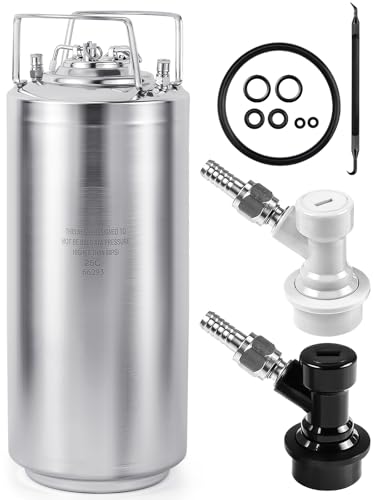
MRbrew 5 Gallon Ball Lock Keg
New stainless cornelius keg sized to hold a standard five gallon batch.

TMCRAFT 5 Gallon Ball Lock Kegs (2 pack)
Two new stainless ball lock kegs, which lets you serve one while the next conditions.

Ferroday 5 Gallon Ball Lock Kegs (2 pack)
Pair of upgraded corny kegs for brewers running more than one beer.

Ferroday 5 ft Ball Lock Beer Line with Picnic Tap
Assembled liquid line with a ball lock disconnect and a picnic tap, which is all you need to pour before a tower exists.
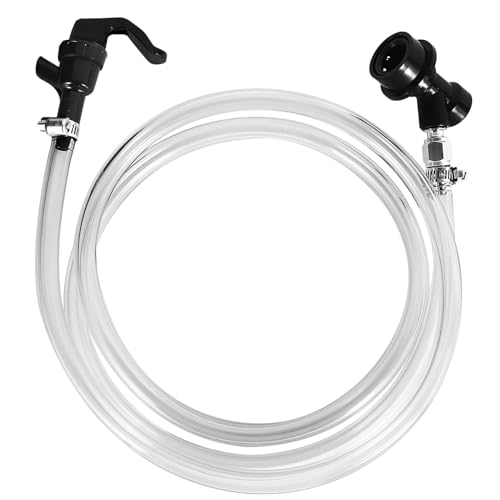
MRbrew 5 ft Ball Lock Beer Line Kit (3/16 inch)
Three sixteenths inch beer hose and picnic tap assembly, the bore that gives correct pour resistance.
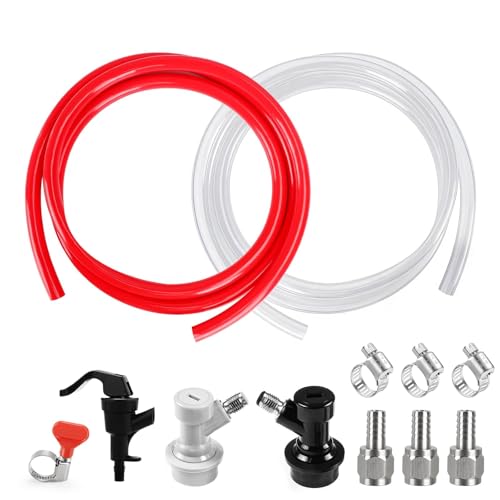
Ball Lock Beer Line and CO2 Gas Line Kit (5 ft each)
Matched liquid and gas line assemblies, which is what a single keg actually needs.
Related on BrewGearCalc
Frequently asked questions
- How long does set and forget carbonation take?
- Usually one to two weeks at serving pressure and temperature. The beer approaches equilibrium gradually because CO2 has to dissolve through the whole volume. It is slower than burst carbonating but it is very hard to get wrong, and once it arrives the carbonation simply stays put as long as temperature and pressure do.
- Why did my beer go flat without me changing anything?
- Check temperature first. CO2 solubility depends strongly on it, so a kegerator that has drifted warmer will push CO2 out of solution and the same regulator setting will now hold less carbonation. A gas leak is the other common cause, and it usually shows up as an empty cylinder far sooner than expected.
- Can I carbonate faster by raising the pressure?
- Yes, that is burst carbonating, and it works. It is also easy to overshoot, and an over-carbonated keg takes considerably longer to correct than it took to create, because you have to vent and re-equilibrate repeatedly. If you are not in a hurry, equilibrium pressure is slower and much harder to spoil.
Researched from published brewing formulas, manufacturer specifications and verified owner reviews. This is general guidance, not professional advice.