Calculator
ABV Calculator
Both published ABV formulas, side by side, with the gap between them shown rather than hidden.
These are both published and they disagree. The standard formula is a linear approximation that holds well for ordinary strength beer and reads increasingly high as gravity climbs. The alternate formula derives alcohol by weight first, then converts, which tracks reality better in strong beer. This calculator shows both and names which is which, because picking one silently is how a number becomes untraceable.
The formula
These are both published and they disagree. The standard formula is a linear approximation that holds well for ordinary strength beer and reads increasingly high as gravity climbs. The alternate formula derives alcohol by weight first, then converts, which tracks reality better in strong beer. This calculator shows both and names which is which, because picking one silently is how a number becomes untraceable.
What rests on a standard and what rests on convention
- Standard Both ABV equations are published and widely used.
- Standard Specific gravity to Plato uses the ASBC cubic polynomial.
A standard is a published equation, a published constant or a manufacturer specification. A convention is widely repeated brewing practice with no governing document behind it. Both are useful. Confusing one for the other is how a habit ends up being quoted as a fact.
Gear for measuring gravity accurately
This grid re-orders itself against the numbers you enter above. Prices are those returned when the page was built and change often.

Brewer's Elite Hydrometer and Test Jar
Triple scale hydrometer with a plastic test jar. Stable gravity on this instrument is the only real proof fermentation has finished.
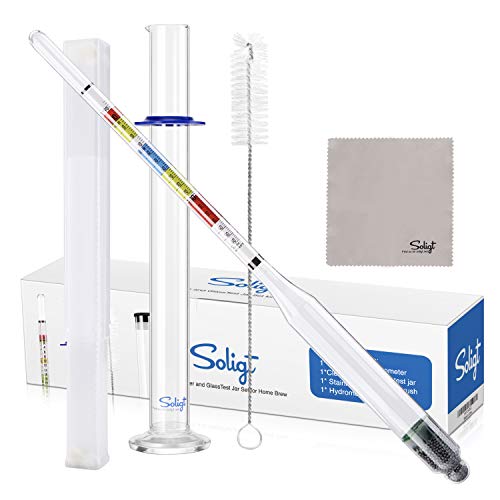
SOLIGT Triple Scale Hydrometer with Glass Test Jar
Hydrometer reading ABV, Brix and specific gravity, supplied with a glass jar.
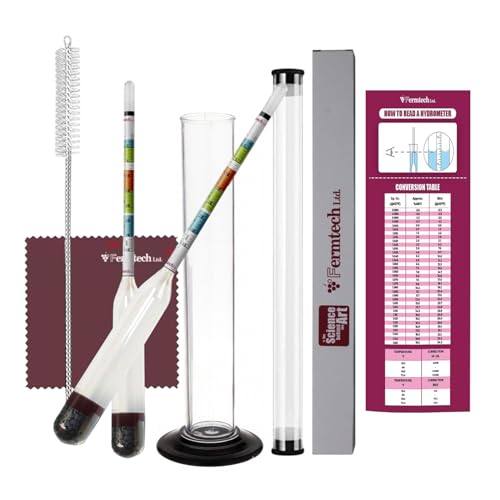
Fermtech Glass Triple Scale Hydrometer Kit
Triple scale glass hydrometer for beer, wine, mead and cider.

Fermentaholics Hydrometer Test Jar
Measuring cylinder for taking a gravity sample without dropping the hydrometer into the fermenter.

Brewing America Glass Hydrometer Test Jar with Brush
Narrow glass flask and cleaning brush, which reads more accurately than a wide vessel.
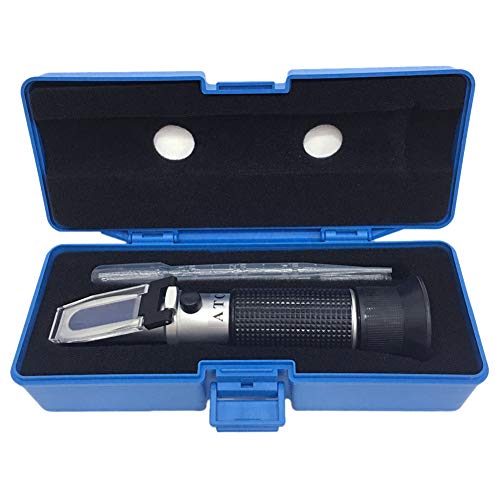
aichose Brix Refractometer with ATC (dual scale)
Dual scale Brix and specific gravity refractometer with automatic temperature compensation, which needs only two drops of wort.

Ade Advanced Optics Beer Wort Refractometer
Dual scale refractometer reading specific gravity 1.000 to 1.120 and Brix, built for wort rather than fruit.

Rhino Beer Refractometer (0 to 32 Brix, ATC)
Brewing specific refractometer covering 0 to 32 Brix and 1.000 to 1.130 gravity with automatic temperature compensation.

LAFMATE Digital Refractometer (0 to 55 Brix)
Digital readout refractometer, which removes the judgement call of reading a blurred line on an optical scale.

Tilt Wireless Hydrometer and Thermometer
A floating sensor that reports gravity and temperature over Bluetooth, so you can confirm stable gravity without opening the fermenter.

Tilt Pro Mini Wireless Hydrometer
The higher resolution Tilt, sized to fit smaller fermenter openings.

Tilt Pico WiFi Adapter
Bluetooth to WiFi bridge that logs a Tilt to the cloud without leaving a phone beside the fermenter.
Related on BrewGearCalc
- ABV worked out for every common gravity pair
- Hydrometer temperature correction
- Refractometer correction after fermentation
- Where the two ABV formulas part company
Frequently asked questions
- Why does this calculator show two different ABV numbers?
- Because two formulas are in common use and they genuinely disagree. The standard formula multiplies the gravity drop by 131.25. The alternate formula works out alcohol by weight and converts it to volume. Near 5 percent they agree within about a tenth of a point. Above roughly 8 percent the gap widens to most of a percentage point, which is large enough to matter when you are labelling a bottle.
- Which ABV formula should I actually use?
- Use the standard formula for ordinary strength beer and the alternate one for strong beer, and say which you used when you quote a figure. Consistency matters more than the choice itself: if you switch formulas between batches, your own records stop being comparable with each other, which defeats the point of recording them.
- Does a stable final gravity prove fermentation finished?
- A single reading proves nothing. Take a gravity sample, wait two or three days, and take another. If it has not moved, fermentation has stopped. Attenuation figures and elapsed time are both poor substitutes. This matters well beyond bookkeeping, because bottling a beer that is still fermenting is one of the two main causes of burst bottles.
Researched from published brewing formulas, manufacturer specifications and verified owner reviews. This is general guidance, not professional advice.