Calculator
Refractometer Correction Calculator
Alcohol refracts differently from sugar, so a raw Brix reading after fermentation is wrong. This corrects it.
The cubic is a published empirical fit. The wort correction factor is NOT: it is instrument and wort specific, commonly quoted near 1.04, and it should really be established by comparing your own refractometer against a hydrometer on the same unfermented wort. Treat a corrected figure as a good estimate, and confirm anything important with a hydrometer.
The formula
The cubic is a published empirical fit. The wort correction factor is NOT: it is instrument and wort specific, commonly quoted near 1.04, and it should really be established by comparing your own refractometer against a hydrometer on the same unfermented wort. Treat a corrected figure as a good estimate, and confirm anything important with a hydrometer.
What rests on a standard and what rests on convention
- Standard The correction cubic is a published empirical fit.
- Convention The 1.04 wort correction factor is instrument specific and should be measured.
A standard is a published equation, a published constant or a manufacturer specification. A convention is widely repeated brewing practice with no governing document behind it. Both are useful. Confusing one for the other is how a habit ends up being quoted as a fact.
Refractometers and hydrometers
This grid re-orders itself against the numbers you enter above. Prices are those returned when the page was built and change often.
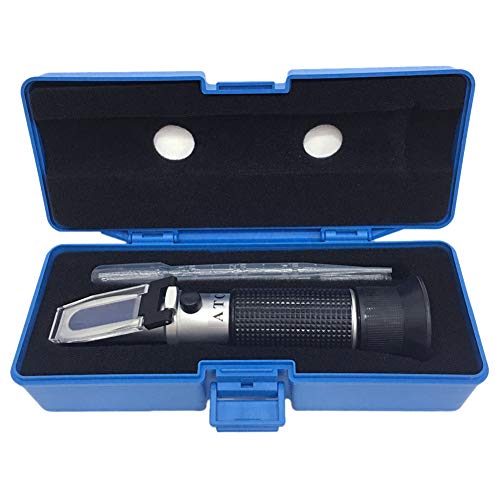
aichose Brix Refractometer with ATC (dual scale)
Dual scale Brix and specific gravity refractometer with automatic temperature compensation, which needs only two drops of wort.

Ade Advanced Optics Beer Wort Refractometer
Dual scale refractometer reading specific gravity 1.000 to 1.120 and Brix, built for wort rather than fruit.

Rhino Beer Refractometer (0 to 32 Brix, ATC)
Brewing specific refractometer covering 0 to 32 Brix and 1.000 to 1.130 gravity with automatic temperature compensation.

LAFMATE Digital Refractometer (0 to 55 Brix)
Digital readout refractometer, which removes the judgement call of reading a blurred line on an optical scale.

Brewer's Elite Hydrometer and Test Jar
Triple scale hydrometer with a plastic test jar. Stable gravity on this instrument is the only real proof fermentation has finished.
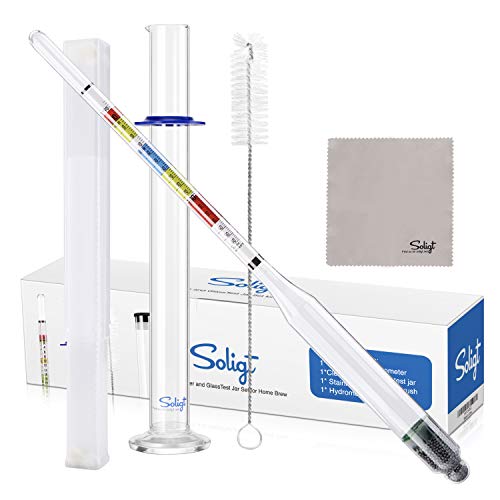
SOLIGT Triple Scale Hydrometer with Glass Test Jar
Hydrometer reading ABV, Brix and specific gravity, supplied with a glass jar.
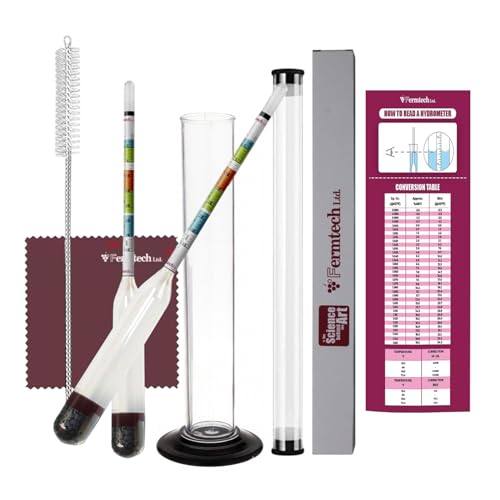
Fermtech Glass Triple Scale Hydrometer Kit
Triple scale glass hydrometer for beer, wine, mead and cider.

Fermentaholics Hydrometer Test Jar
Measuring cylinder for taking a gravity sample without dropping the hydrometer into the fermenter.

Brewing America Glass Hydrometer Test Jar with Brush
Narrow glass flask and cleaning brush, which reads more accurately than a wide vessel.
Related on BrewGearCalc
Frequently asked questions
- Why can I not just read Brix during fermentation?
- A refractometer measures how much light bends passing through the sample, and it is calibrated assuming the only thing dissolved is sugar. Alcohol bends light differently, so once fermentation produces alcohol the instrument reads high and the error grows as fermentation proceeds. The correction above models that, but it is a model, not a measurement.
- What is the wort correction factor and why 1.04?
- Refractometers are calibrated against sucrose solutions, and wort is not sucrose, so readings need a small scaling factor. Around 1.04 is commonly quoted. It is genuinely instrument and wort specific, so the better approach is to measure unfermented wort with both a refractometer and a hydrometer and divide to get your own factor.
- Should I trust this over a hydrometer?
- No. For a final gravity that decides whether you bottle, use a hydrometer. The refractometer is excellent during the brew day and for tracking fermentation progress on a few drops, but the corrected final gravity carries model error plus your correction factor error. Confirm the decision to bottle with a hydrometer reading that has been stable for days.
Researched from published brewing formulas, manufacturer specifications and verified owner reviews. This is general guidance, not professional advice.