Compare
Hydrometer vs Refractometer
A hydrometer is the reference instrument: it needs a full sample, but a reading that holds steady across several days on a glass hydrometer like the SOLIGT Triple Scale Hydrometer at $18.98 is the only real proof fermentation has finished. A refractometer like the Rhino Beer Refractometer at $28.90 needs only two drops of wort and is excellent on brew day, but a raw Brix reading taken after fermentation starts is meaningless without correction.
Most brewers who stick with the hobby end up owning both: a refractometer for fast checks at the mash tun and kettle, and a hydrometer for the one reading that actually decides when to bottle.
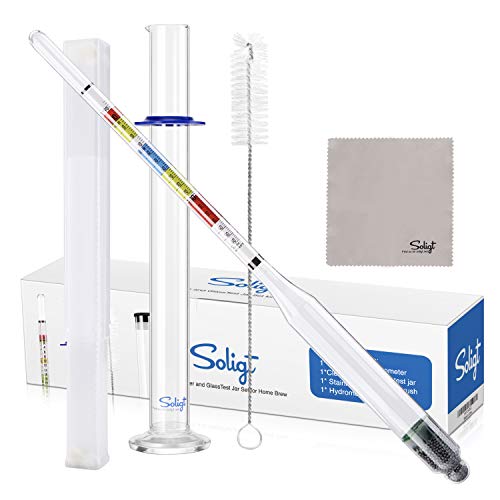
SOLIGT Triple Scale Hydrometer with Glass Test Jar
SOLIGT
It is the one instrument here whose reading never needs a correction for alcohol content, which is exactly why it stays the reference for deciding whether a beer is actually done.
Price last checked at publication and changes often.
Two different jobs that get treated as one purchase
A hydrometer and a refractometer both estimate the concentration of dissolved sugar in a liquid, and both output a number that a brewing calculator can use. That similarity is where the confusion starts, because the two tools are built for different moments in the process and behave very differently once alcohol enters the picture. Buying one to replace the other, rather than understanding what each one is actually good at, is the most common mistake here.
A refractometer is a brew day tool. A hydrometer is a fermentation tool. Neither description is a knock on the other instrument; it is just where each one is reliable without qualification.
What a hydrometer requires, and why it stays the reference
A hydrometer floats in a full sample, typically poured into a dedicated test jar rather than dipped straight into the fermenter, and it reads the liquid's density directly against a printed scale. That direct density reading is exactly why it remains the reference instrument: it does not care whether the dissolved material lowering that density is leftover sugar, alcohol, or both, because a beer's final gravity is itself a combined number, not a sugar-only number.
A hydrometer is calibrated at a stated temperature, commonly 60 degrees Fahrenheit, and a reading taken from a warm sample reads lower than the true gravity until it is corrected. This site's hydrometer correction calculator handles that adjustment properly, since the correction is not a flat number across the whole temperature range.
What a refractometer requires, and why it earns a place on brew day
A refractometer needs only a couple of drops placed on its prism, and it gives a reading in seconds with no waiting for a sample to settle at a reference temperature the way a hydrometer needs. That speed and tiny sample size make it genuinely excellent for quick checks pulled straight off the mash tun or the kettle, where confirming efficiency or boil concentration matters and there is no alcohol in the liquid yet to complicate the reading.
Every unit worth buying includes automatic temperature compensation, which corrects internally for the sample's temperature so there is no separate cooldown step. This site's refractometer calculator is built for the other half of the job: correcting a reading once fermentation has started.
The correction math is standard; the 1.04 factor commonly plugged into it is not
Once fermentation begins, the liquid on a refractometer's prism is no longer just water and sugar. It is water, unfermented sugar, and alcohol, and alcohol bends light differently than sugar does. A raw Brix reading taken at that point is not simply less accurate, it is not a usable number at all without correction.
The formula that turns a starting gravity and a raw refractometer reading into a corrected finishing gravity is a published empirical cubic fit, a standard piece of math used across brewing calculators, including this site's refractometer calculator. What is not standard is the wort correction factor commonly plugged into a simplified version of that formula, usually somewhere near 1.04. That number is a widely repeated convention, not a measured constant, and it is specific to the individual instrument. The accurate way to find a given refractometer's own factor is to take a hydrometer reading and a refractometer reading of the same sample at a few points during fermentation and solve for the factor that makes the corrected refractometer number match the hydrometer.
For the decision to bottle, the hydrometer wins, plainly
For a final gravity that decides whether you bottle, the hydrometer wins. It reads the beer's actual combined density with no correction factor standing between the number on the scale and the real answer. A corrected refractometer estimate is a useful cross-check once its instrument-specific factor has actually been measured, but it is a second opinion, not the primary source, on the one number that determines whether it is safe to prime and bottle.
Airlock activity slowing down is not proof of anything, and neither is a single refractometer reading, corrected or not. Stable gravity across several days on a hydrometer is the only real proof fermentation has finished.
Sample size and how often each one gets used
A hydrometer's full sample, once pulled and read, is usually not returned to the fermenter, which means each check costs a small amount of beer and opens the vessel to a brief oxidation and infection risk. A refractometer's two drops cost essentially nothing and do not require opening a sealed fermenter at all if the sample is pulled through a spigot or sample port instead.
That difference is exactly why a refractometer is used often, sometimes several times during a single brew day, while a hydrometer is typically used only a handful of times per batch: once before fermentation, and then in pairs a few days apart near the end to confirm the gravity has actually stopped moving.
Using both together across a single batch
A practical workflow uses a refractometer on brew day for a fast pre-boil check of mash efficiency and a post-boil check of starting gravity, both taken with no correction needed since fermentation has not started. From that point forward, the hydrometer takes over: one reading a few days into fermentation to see progress, then a pair of readings three to four days apart near the expected finish to confirm the gravity has actually stopped dropping.
This split plays to what each instrument is genuinely good at rather than trying to make one tool cover the entire process. A refractometer used only after fermentation starts, without ever correcting the reading, is the single most common way this pairing goes wrong.
Common reading mistakes that affect either instrument
A hydrometer reading taken at an angle rather than straight across at eye level introduces parallax error that consistently skews the result in one direction, and trapped air bubbles clinging to the bulb add buoyancy that was never part of its calibration, so a gentle spin after lowering it into the sample helps clear them before reading. The correct point to read is the bottom of the meniscus, the slight curve where the liquid meets the stem, not the higher ring where liquid climbs the glass.
A refractometer's prism needs a clean, dry surface before each new sample, since a leftover film from a previous reading can shift the result slightly. Reading it under harsh direct light or through a scratched daylight plate can also blur the line between light and dark that the scale is read against, which is worth checking before assuming the instrument itself is at fault for an odd reading.
How the options compare
| Feature | Hydrometer | Refractometer |
|---|---|---|
| Sample needed | A full sample poured into a test jar | Two to three drops on the prism |
| Accurate after fermentation starts | Yes, reads density directly | No, needs a correction formula and an instrument-specific factor |
| Speed of a single reading | Slower; needs the sample at a known temperature | Seconds, with ATC built in |
| Best use | Confirming fermentation is finished | Quick checks at the mash tun and kettle |
| Typical price in this catalog | $14.99 to $21.99 for glass models | $18.99 to $29.25 |
Cleaning and storing both instruments between batches
A glass hydrometer and its test jar need the same sanitizing routine as any other equipment that touches wort or beer, since a quick dip in a no-rinse sanitizer before use is enough to keep a repeatedly used tool from becoming a contamination source. Storing a hydrometer upright in something padded, rather than loose in a drawer with metal tools, meaningfully reduces the chance of a chipped stem or a cracked bulb over years of use.
A refractometer's prism should be wiped clean with a soft cloth immediately after each use rather than left to dry with residue on it, since dried sugar or wort film left on the prism can affect the next reading and is more work to remove once it has hardened. A padded case, often included with the unit, protects the optics from the kind of impact that a calibration screw cannot fully correct for afterward.
How we chose
These picks come from published scale ranges, glass and prism specifications, and calibration claims, along with verified owner reviews on accuracy, durability, and ease of reading. This is not the result of personal hands-on testing of these specific units. Where a listing's stated range did not cover typical wort gravity, that model was excluded regardless of price.
The three tiers
These are three genuinely different builds, not the same product at three prices. Buy the tier that matches how much you already know you will use it.
Fermtech Glass Triple Scale Hydrometer Kit
Fermtech
At $14.99 it is the cheapest complete hydrometer kit here, and a hydrometer is the one instrument every new brewer actually needs before worrying about a refractometer at all.
$14.99
View on AmazonRhino Beer Refractometer (0 to 32 Brix, ATC)
RHINO TECHNOLOGY
At $28.90 its 0 to 32 Brix range sits directly over where wort actually falls, adding fast pre-boil and post-boil checks to a setup that already has a hydrometer for the readings that matter after fermentation starts.
$28.90
View on AmazonTilt Wireless Hydrometer and Thermometer
Tilt
At $135.00 it logs specific gravity and temperature to a phone for an entire fermentation without opening the vessel, useful for frequent brewers and pressure fermenters. Someone brewing a handful of batches a year does not need this; a fifteen dollar glass hydrometer does the one job that actually matters just as completely.
$135.00
View on AmazonEverything else worth considering

Brewer's Elite Hydrometer and Test Jar
Triple scale hydrometer with a plastic test jar. Stable gravity on this instrument is the only real proof fermentation has finished.

Ade Advanced Optics Beer Wort Refractometer
Dual scale refractometer reading specific gravity 1.000 to 1.120 and Brix, built for wort rather than fruit.

LAFMATE Digital Refractometer (0 to 55 Brix)
Digital readout refractometer, which removes the judgement call of reading a blurred line on an optical scale.
Before you do this
Trusting an uncorrected refractometer reading, or a single reading of any kind, as proof that fermentation has finished is a real way to bottle too early. Confirm with a hydrometer reading that holds steady across several days before priming a single bottle.
Related on BrewGearCalc
- Hydrometer correction calculator
- Refractometer correction calculator
- ABV calculator
- Best hydrometers
- Best refractometers
- Wireless hydrometer vs a glass one
Frequently asked questions
- Can a refractometer replace a hydrometer completely?
- No. A refractometer gives an accurate Brix reading before fermentation starts, since the liquid is mostly water and sugar at that point. Once alcohol is present, a raw reading is not usable without a correction factor that is specific to your instrument. Most brewers keep both: a refractometer for quick brew day checks, and a hydrometer to confirm the beer has actually finished fermenting before bottling.
- Why does my refractometer read higher than my hydrometer during fermentation?
- Alcohol bends light differently than sugar does, and a refractometer cannot tell the two apart. Once yeast has converted some sugar to alcohol, a raw reading overstates the remaining gravity because it reads the combined effect of leftover sugar and alcohol as if it were all sugar. Running the starting gravity and current raw reading through a correction calculator removes that error.
- Is the 1.04 refractometer correction factor accurate for my instrument?
- It is a commonly used starting point, not a guaranteed number for every refractometer. The real factor varies from one instrument to another. The accurate way to find yours is to compare a refractometer reading against a hydrometer reading of the same sample partway through fermentation, and solve for the factor that makes the two agree, then reuse that factor going forward.
- Which instrument tells me it's safe to bottle?
- The hydrometer does. A stable specific gravity reading held across several days in a row is the only real proof fermentation has finished. A refractometer, even corrected, is a useful second opinion once its own correction factor has been properly measured, but the hydrometer's direct density reading is the one that should decide when priming sugar goes in.
- Do I need both a hydrometer and a refractometer?
- Not strictly, but most brewers who stay in the hobby end up with both. A hydrometer alone covers everything a batch needs from start to finish. A refractometer adds speed and a tiny sample size for pre-boil and post-boil checks on brew day, which is convenient but not required, since a hydrometer can do that job too, just more slowly.
- How much sample does each instrument actually need?
- A hydrometer needs a full sample, usually a few ounces poured into a dedicated test jar, and that sample is typically not returned to the fermenter. A refractometer needs only two or three drops placed directly on its prism, which is why it can be used often during a brew day without meaningfully affecting batch volume or requiring the fermenter to be opened.
Researched from published brewing formulas, manufacturer specifications and verified owner reviews. This is general guidance, not professional advice.