Compare
Wireless Hydrometer vs a Glass One
A wireless hydrometer like the Tilt Black at $135.00 reports gravity and temperature continuously through the fermenter wall, which avoids opening the vessel and the small oxygen pickup and infection risk that comes with pulling a sample. It should still be checked against a glass hydrometer, such as the SOLIGT Triple Scale Hydrometer at $18.98, before you trust it on a real batch.
For most home brewers doing a handful of batches a year, a glass hydrometer does the exact same core job for a fraction of the price.
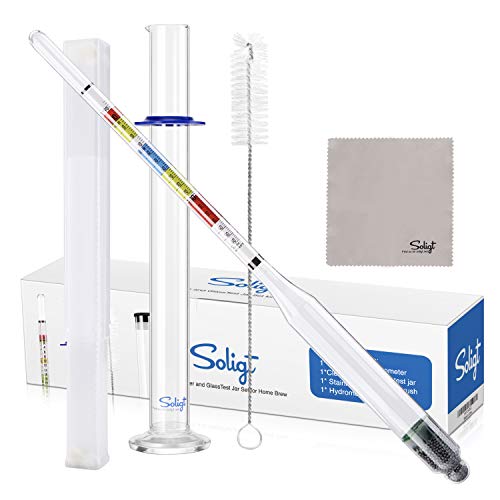
SOLIGT Triple Scale Hydrometer with Glass Test Jar
SOLIGT
It gives the same reference-grade density reading as a wireless unit for roughly an eighth of the price, with no battery, app, or Bluetooth pairing to manage.
Price last checked at publication and changes often.
Two instruments built on the same physical principle
A wireless hydrometer and a glass hydrometer both float in liquid and both measure density the same way a hydrometer always has. The Tilt is, underneath its sealed plastic shell, a floating hydrometer with a small circuit board and a wireless radio added, not a fundamentally different way of measuring gravity. Understanding that is the whole comparison: the physics did not change, the packaging and the reporting method did.
That means neither instrument is inherently more accurate than the other at the level of the raw reading. What actually differs is how the sample is taken, how often a reading happens, and what it costs to get that convenience.
Sampling method: pull a sample, or leave the unit in place
A glass hydrometer needs a full sample pulled from the fermenter and poured into a dedicated test jar, then read at eye level. Doing that opens the fermenter briefly, which is a small oxidation and infection risk each time, and the sample itself is usually not returned to the batch afterward.
A wireless hydrometer reports gravity continuously without opening the fermenter, which avoids that oxygen pickup entirely, since the unit sits inside the vessel for the whole fermentation and transmits its reading through the wall of most plastic and glass fermenters without anyone lifting the lid.
It should still be checked against a glass hydrometer
A wireless unit reporting a number on a phone screen is not automatically correct for your specific unit and your specific fermenter geometry. Before relying on it for a real batch, take a glass hydrometer reading of the same beer at roughly the same time the wireless unit reports its number, and compare the two. A consistent offset between the two readings is common and easy to account for once it is known; an offset that changes unpredictably is a sign something is wrong with placement, calibration, or the sample itself.
This check matters most early in a fermentation, before you have built confidence in how a specific wireless unit tracks against a known reference in your own equipment.
Calibration temperature applies to both instruments
A hydrometer, wireless or glass, is calibrated at a stated temperature, commonly 60 degrees Fahrenheit, and a warm reading is wrong until it is corrected. A glass hydrometer relies on you to know the sample's temperature and apply that correction, which this site's hydrometer correction calculator handles properly since the adjustment is not a flat number across the whole range.
A wireless logger typically reports temperature alongside gravity and applies its own internal compensation, but the same underlying density-versus-temperature physics is still there. A number that looks automatically corrected is worth understanding rather than blindly trusting, especially the first few times you compare it against a glass hydrometer reading.
What the extra cost of a wireless unit actually buys
A glass triple scale hydrometer runs from roughly $14.99 to $21.99 in this catalog. A Tilt runs $135.00 to $175.00 depending on the model, six to nine times the price of the cheapest glass option. That premium buys continuous logging without opening the fermenter, which is genuinely valuable for anyone fermenting under pressure, since a pressure vessel is a bigger deal to open just for a gravity check, or for anyone brewing often enough that pulling a sample every time gets tedious.
It does not buy a more accurate raw reading than a glass hydrometer already gives you. The value is entirely in convenience and reduced fermenter opening, not in the fundamental precision of the measurement itself.
Who actually benefits from a wireless logger
Frequent brewers running multiple fermenters at once, anyone using a pressure fermenter where opening the vessel means releasing pressure and resealing it, and anyone fermenting in a narrow-neck conical where pulling a clean sample is awkward are the clearest cases for a wireless unit. The convenience compounds across many batches for these brewers in a way it simply does not for someone brewing two or three times a year.
A brewer in a bucket with a simple airlock, checking gravity a handful of times per batch, gets little practical benefit from a Tilt that a fifteen dollar glass hydrometer and test jar do not already provide, and that glass hydrometer, handled carefully, typically lasts for years of batches without needing a battery or a firmware update.
Setting up a wireless unit for a new batch
A wireless hydrometer needs to float freely and settle without touching the sides of the fermenter, the same requirement a glass hydrometer has inside its test jar, just inside a much larger vessel. Placement matters more here than with a glass hydrometer, since a unit wedged against a wall or resting at an angle can report a skewed reading indefinitely rather than just once.
Pairing a wireless unit's app with a phone or a home hub before pitching yeast is worth doing early rather than mid-fermentation, since troubleshooting a connection problem after the fact means losing logging data for whatever period the unit was not communicating.
What to do when the two readings disagree by a meaningful amount
A small, consistent gap between a wireless unit and a glass hydrometer reading, in the same direction every time, is normal and simply becomes part of how that specific unit is read going forward. A gap that grows over the course of a fermentation, or that flips direction unpredictably, points to something worth investigating rather than ignoring: a battery running low, the unit resting against the fermenter wall, or trub building up around it as fermentation progresses.
Pulling a fresh glass hydrometer sample at that point and comparing it directly against the wireless unit's current reading is the fastest way to tell whether the wireless unit needs recalibrating in its app settings or whether something in the fermenter itself has shifted, such as the unit settling into a layer of yeast sediment that changes its buoyancy.
How the options compare
| Feature | Glass hydrometer | Wireless hydrometer |
|---|---|---|
| Opens the fermenter to read | Yes, every time | No, reports through the wall |
| Price in this catalog | $14.99 to $21.99 | $45.00 to $175.00 |
| Needs a battery | No | Yes |
| Best for | Occasional brewers, tight budgets | Frequent brewers, pressure fermenters |
| Should be checked against | A known reference, like distilled water | A glass hydrometer reading of the same sample |
Battery life and long-term ownership
A wireless unit runs on a battery that needs periodic replacement, and battery life varies with how often the unit reports and how far it has to transmit through the fermenter wall and any surrounding insulation. A glass hydrometer has no battery at all and, handled carefully, can genuinely outlast a wireless unit's electronics across many years of batches without any ongoing cost beyond an occasional replacement test jar.
Firmware updates and app changes on a wireless unit are also something a purely mechanical glass hydrometer never has to deal with, which is worth factoring in for a brewer who values a tool that works the same way indefinitely over one with more features to maintain.
What happens if the battery dies mid-fermentation
A wireless unit that goes silent partway through a fermentation leaves a gap in the logged data, and unlike a glass hydrometer, there is no way to retroactively know what the gravity was doing during that gap once the battery is replaced. Checking a fresh battery level before starting a batch that will run for an extended stretch, and keeping a glass hydrometer on hand as a fallback, avoids losing track of a fermentation's progress entirely if the wireless unit stops reporting partway through.
This is one more reason a glass hydrometer earns a permanent place in a brewer's kit even after buying a wireless logger: it is the fallback that keeps working the moment a battery runs out or a connection drops.
How we chose
These picks come from published specifications on scale accuracy, wireless range, and battery life, and from verified owner reviews describing consistency against known references. This is not the result of personal hands-on testing of these specific units. Reviews that consistently described unreliable Bluetooth range or drift over long fermentations were weighed against otherwise favorable pricing and features.
The three tiers
These are three genuinely different builds, not the same product at three prices. Buy the tier that matches how much you already know you will use it.
Fermtech Glass Triple Scale Hydrometer Kit
Fermtech
At $14.99 it covers every gravity reading a first batch needs, with a test jar included and nothing extra to learn or charge.
$14.99
View on AmazonBrewer's Elite Hydrometer and Test Jar
Brewer's Elite
At $21.99 it adds sturdier glass and an easier-to-read jar, a real upgrade for someone bottling several batches a year without spending anywhere near what a wireless unit costs.
$21.99
View on AmazonTilt Wireless Hydrometer and Thermometer
Tilt
At $135.00 it removes the need to open the fermenter for every check, which pays off for frequent brewers and pressure fermenters. Anyone brewing a few batches a year, or on a tight budget, should stay with a glass hydrometer instead; it does the same core job for a fraction of the price.
$135.00
View on AmazonEverything else worth considering

Fermentaholics Hydrometer Test Jar
Measuring cylinder for taking a gravity sample without dropping the hydrometer into the fermenter.

Brewing America Glass Hydrometer Test Jar with Brush
Narrow glass flask and cleaning brush, which reads more accurately than a wide vessel.

Tilt Pro Mini Wireless Hydrometer
The higher resolution Tilt, sized to fit smaller fermenter openings.

Tilt Pico WiFi Adapter
Bluetooth to WiFi bridge that logs a Tilt to the cloud without leaving a phone beside the fermenter.
Before you do this
For a final gravity that decides whether you bottle, the hydrometer, wireless or glass, wins over guesswork. A reading that has held steady across several days is the only real check that fermentation is actually finished; bottling before that point is how a sealed bottle builds enough pressure to fail.
Related on BrewGearCalc
- Hydrometer correction calculator
- ABV calculator
- Best hydrometers
- Best pressure fermenters
- Hydrometer vs refractometer
Frequently asked questions
- Is a Tilt as accurate as a glass hydrometer?
- Both measure density the same way, so neither has an inherent accuracy advantage at the raw reading level. What matters is checking your specific wireless unit against a glass hydrometer reading of the same sample before trusting it on a real batch. A consistent, predictable offset between the two is normal and easy to account for once identified.
- Do I still need a glass hydrometer if I own a Tilt?
- Yes, at least for the first several batches. A glass hydrometer is how you confirm a wireless unit is reading correctly in your specific fermenter, and many brewers keep one on hand permanently as a cheap cross-check. It is also a reasonable backup if a wireless unit's battery dies or its Bluetooth connection drops mid-fermentation.
- Can a wireless hydrometer be used in a pressure fermenter?
- This is one of the strongest use cases for a wireless unit, since checking gravity in a pressure fermenter with a glass hydrometer means releasing pressure and reopening a sealed vessel just to pull a sample. A wireless logger reports gravity through the vessel wall without touching the seal, which avoids that disruption entirely during fermentation.
- Why does my Tilt reading drift from my hydrometer over time?
- Some drift between a wireless unit and a glass hydrometer reading is common and often consistent in one direction, which is easy to account for once identified. Drift that changes unpredictably, or grows steadily worse, is more likely tied to unit placement, fermenter shape, or a battery running low, and is worth cross-checking again with a fresh glass hydrometer sample.
- Is a wireless hydrometer worth it for someone who only brews a few times a year?
- Usually not. The core value of a wireless unit is avoiding repeated fermenter openings across frequent brewing or in a pressure vessel. An occasional brewer checking gravity a handful of times per batch gets little practical benefit from that convenience relative to a glass hydrometer that costs six to nine times less and needs no battery.
- What is the Tilt Pico and do I need one?
- The Tilt Pico is a WiFi adapter that relays a Tilt's Bluetooth signal further than a phone alone can reach, useful if the fermenter sits somewhere a phone does not maintain a steady Bluetooth connection, such as a separate room or a garage. It is not required for a Tilt to function at all, only for extending its logging range.
Researched from published brewing formulas, manufacturer specifications and verified owner reviews. This is general guidance, not professional advice.