Best Gear
Best Pressure Fermenters
The VEVOR 16-gallon Pressure Fermenter, rated to 15 PSI, is the best pressure fermenter for most home brewers at $314.50, with enough capacity to hold a 5-gallon batch and its krausen while fermenting and carbonating under pressure in the same vessel.
A converted 5-gallon corny keg is a cheaper route into pressure fermenting, but it needs a compatible fitting and a regulator that the keg itself does not include.
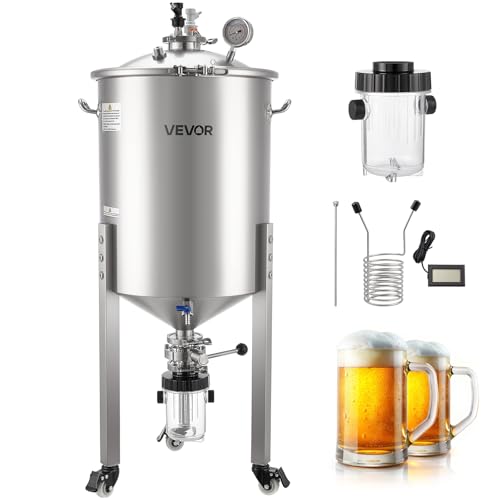
VEVOR Pressure Fermenter 15 PSI (16 gal)
VEVOR
It is the largest 15 PSI-rated pressure fermenter in this catalog, giving a 5-gallon batch real headspace for krausen while still holding pressure, which the smaller 8-gallon version has less margin for.
Price last checked at publication and changes often.
Why pressure fermenting is different from a sealed bucket
A pressure fermenter is not just a fermenter with a tighter lid. It is built with a rated seal and, in most setups, a fitting for a spunding valve, so the CO2 produced during active fermentation can be held inside the vessel instead of venting through an airlock. Holding that CO2 in solution is what lets a brewer both ferment and naturally carbonate a beer in one vessel, and it is also what lets some yeast strains ferment cleaner at warmer temperatures under back pressure.
This is also the single most important safety point on this page: a sealed fermenter with no working airlock or pressure relief can burst. A pressure-rated vessel like the two VEVOR fermenters in this catalog has a published pressure rating, 15 PSI, and that number is a real engineering limit, not a marketing figure. A vessel that is not built and rated for pressure, including a standard plastic bucket or a glass carboy, must never be sealed tight the way a rated pressure fermenter can be. The published rating exists because uncontrolled pressure from fermentation has to go somewhere, and in an unrated vessel it goes through the weakest seam.
The two purpose-built pressure fermenters in this catalog are both rated to 15 PSI. That rating is a ceiling, not a target; the working pressures many home brewers actually hold with a spunding valve vary by beer style as a matter of brewing convention rather than a fixed number, and running near a vessel's rated limit on a gauge is not the same as running at a comfortable working pressure.
How the options compare
| Option | Capacity | Rated pressure | Price | Note |
|---|---|---|---|---|
| VEVOR Pressure Fermenter 15 PSI (8 gal) | 8 gal | 15 PSI | $193.90 | Purpose-built, smaller footprint |
| VEVOR Pressure Fermenter 15 PSI (16 gal) | 16 gal | 15 PSI | $314.50 | More headspace for a 5-gallon batch’s krausen |
| TMCRAFT 5 Gallon Ball Lock Corny Keg (converted) | 5 gal | Not published for fermenting use | $123.49 | Budget route, needs a fitting and a regulator |
| Ferroday Dual Gauge CO2 Regulator (0-120 PSI) | n/a | 0 to 120 PSI gauge range | $45.99 | Needed to read and control pressure on either setup |
The corny keg route, and its real limits
A well-known practice in home brewing is fermenting inside a 5-gallon corny keg fitted with a spunding valve on the gas post, which lets a brewer hold back pressure using gear a lot of kegging setups already own. A corny keg like the ones in this catalog is built to hold pressure for serving beer, but none of the keg listings here publish a pressure rating specific to fermentation use, and a standard keg lid was designed for dispensing finished beer, not for holding back the CO2 output of an active, vigorous fermentation. Brewers who go this route are relying on the keg's serving pressure rating and a regulator's relief function, not on a fermentation-specific rating.
Doing this safely still means the same rule applies: there has to be a way for pressure to vent before it exceeds what the vessel and its fittings can hold. A spunding valve, which is a pressure relief valve tuned to a target pressure, is what makes this practice survivable, and running one without a way to verify pressure with a gauge, like the Ferroday dual gauge regulator in this catalog, is not a shortcut worth taking.
The purpose-built VEVOR pressure fermenters remove that guesswork. They ship with a wide lid designed for pitching and dry hopping, a published 15 PSI rating, and fittings meant for this exact use, which is why they are the simpler and safer recommendation for anyone doing this more than once or twice.
A brewer already invested in kegging equipment, tanks, regulators and ball lock fittings, often finds the marginal cost of trying the corny keg method very low, which is the main reason it stays popular despite the added inconvenience of pitching yeast through a narrow keg opening.
Closed transfers: the other reason to ferment under pressure
Holding pressure in a fermenter also enables what is usually called a closed transfer, moving finished beer directly into a keg using the fermenter's own CO2 pressure and a length of tubing, without opening either vessel to the air. This matters most for hop-forward styles prone to oxidation, since a closed transfer avoids exposing the beer to oxygen at the single most vulnerable point in the whole process, the transfer from fermenter to package. A standard bucket or carboy has no way to do this safely, since it has no pressure to push the beer and no rated seal to hold any pressure that built up anyway.
Setting up a closed transfer needs a dip tube reaching to the bottom of the fermenter, a gas-in fitting at the top, and a keg on the receiving end at a lower pressure than the fermenter, so beer moves from high pressure to low pressure through the tubing without a pump. The purpose-built VEVOR pressure fermenters in this catalog are designed with these fittings already in mind, which is a real advantage over adapting a corny keg, where the fittings were built for serving beer outward, not for a controlled one-way transfer from a fermenter.
What to check before buying either pressure fermenter
The published 15 PSI rating on both VEVOR pressure fermenters in this catalog is the vessel's structural limit, but the practical limit for a given batch also depends on the seals, gaskets and fittings staying in good condition. A gasket that has dried out, cracked or been pinched during a previous lid closure can leak or fail well below the vessel's rated pressure, which is why inspecting the seal before every pressure-fermented batch matters as much as knowing the published number in the first place.
Capacity choice between the 8-gallon and 16-gallon VEVOR models should account for headspace the same way any fermenter does, plus a bit of extra margin, since a pressure fermenter is sealed tighter than an airlocked one and gives less visual warning that krausen is approaching the lid. A brewer fermenting a single 5-gallon batch at a time can use either size safely with attention to fill level, but the 16-gallon version removes some of that margin for error.
A pressure gauge on the regulator is not optional equipment for this kind of fermenting, it is the only real way to confirm what is actually happening inside a sealed vessel. A brewer relying on a spunding valve alone, without a gauge to read against it, has no way to know whether the valve is holding near its set point or has drifted, and drift in either direction either wastes carbonation or pushes closer to the vessel's rated limit than intended.
Sizing for headspace still applies
Pressure does not eliminate the need for headspace, it changes what a brewer is managing. In an open or airlocked fermenter, krausen that rises too high pushes into the airlock. In a pressure fermenter, krausen that rises too high can foul the pressure relief fitting or the dip tube used for closed transfers, which is worse, because a fouled relief fitting may not vent when it needs to. The 5-gallon-batch-wants-6.5-gallons convention still applies, and the 16-gallon VEVOR unit gives noticeably more margin than the 8-gallon version for a full 5-gallon batch fermented at a vigorous pace.
How we chose
These picks come from the published PSI ratings, capacities and fitting specifications listed by each manufacturer, along with verified owner reviews describing seal reliability and real-world use with spunding valves. This is written from specifications and reported owner experience, not from pressure-testing any fermenter in a shop.
The three tiers
These are three genuinely different builds, not the same product at three prices. Buy the tier that matches how much you already know you will use it.
TMCRAFT 5 Gallon Ball Lock Corny Keg
TMCRAFT
At $123.49 this is the cheapest way into pressure fermenting, repurposing a 5-gallon corny keg most kegging setups already know how to use. It was not built as a fermenter, so it needs a spunding valve and a way to pitch yeast through its narrow opening, which a purpose-built pressure fermenter's wide lid avoids.
$123.49
View on AmazonVEVOR Pressure Fermenter 15 PSI (8 gal)
VEVOR
An 8-gallon vessel rated to 15 PSI for $193.90, purpose-built with a wide lid for pitching and dry hopping, and fittings meant for a spunding valve rather than adapted from a serving keg.
$193.90
View on AmazonVEVOR Pressure Fermenter 15 PSI (16 gal)
VEVOR
The 16-gallon version of the same 15 PSI-rated design for $314.50, with enough headspace to run a full 5-gallon batch through a vigorous fermentation without crowding the relief fitting. A brewer doing occasional small batches, or short on shelf space, does not need the extra size and should buy the 8-gallon version instead.
$314.50
View on AmazonEverything else worth considering
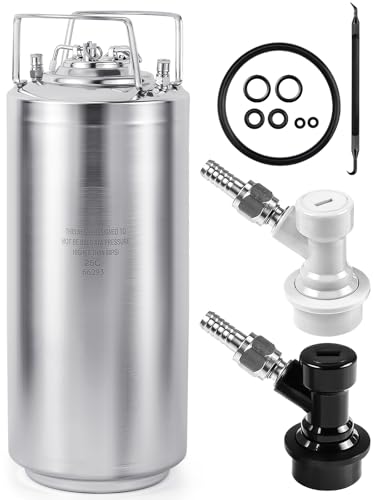
MRbrew 5 Gallon Ball Lock Keg
New stainless cornelius keg sized to hold a standard five gallon batch.

Hilangsan 5 Gallon Cornelius Keg
Stainless ball lock corny keg at entry pricing.

Ferroday 0 to 120 PSI Dual Gauge CO2 Regulator
Higher range dual gauge regulator, useful when burst carbonating.

SPARC Gen2 Premium CO2 Regulator
Single output CO2 keg regulator with a CGA-320 inlet.
Before you do this
A sealed fermenter with no working airlock or pressure relief can burst. Pressure-rated vessels like the VEVOR fermenters here publish a real 15 PSI limit; never seal a bucket, carboy or non-rated conical the way a rated pressure fermenter can be sealed, and always run a spunding valve set well under a vessel's published ceiling.
Related on BrewGearCalc
- Best fermenters for home brewing
- Best conical fermenters
- Best fermentation temperature control
- Keg carbonation calculator
- Priming sugar calculator
Frequently asked questions
- Is it safe to ferment beer in a sealed pressure fermenter?
- Yes, as long as the vessel is actually rated for pressure and has a working relief path, such as a spunding valve set below its rated limit. A pressure-rated fermenter like the VEVOR models in this catalog publishes a 15 PSI limit for exactly this reason. What is never safe is sealing a vessel that has no published pressure rating and no working relief; a sealed fermenter with no working airlock or pressure relief can burst.
- Can I ferment under pressure in a regular bucket or carboy?
- No. Standard plastic buckets, glass carboys and PET carboys are not built or rated to hold back pressure and must always vent through a working airlock. Sealing one of these vessels tightly during active fermentation risks a burst seam, a blown lid, or a cracked carboy, since the vessel has no published pressure rating and no engineered relief path. Only use a vessel explicitly rated for pressure, like the VEVOR fermenters in this catalog, for pressure fermenting.
- What is a spunding valve and do I need one?
- A spunding valve is a pressure relief valve set to release CO2 once fermentation pressure passes a chosen threshold, which is what allows a sealed vessel to hold back carbonation safely instead of building pressure without limit. Anyone fermenting under pressure, whether in a purpose-built pressure fermenter or a converted keg, needs one along with a way to read pressure on a gauge. It is not optional safety equipment for this technique.
- Can I use a corny keg as a pressure fermenter?
- Many home brewers do, fitting a 5-gallon keg with a spunding valve on the gas post, but no corny keg listing publishes a pressure rating specific to fermentation use, only for serving. A standard keg lid also was not designed for pitching yeast or dry hopping the way a purpose-built pressure fermenter's wide lid is. It works, but it relies on the keg's serving rating and a working relief valve, not on a fermentation-specific rating.
- What PSI should I ferment at?
- There is no single published number; working pressure during fermentation is a matter of brewing convention that varies by yeast strain and target carbonation, and it should always stay well under a vessel's rated ceiling. The VEVOR pressure fermenters in this catalog are rated to 15 PSI, and that figure is a maximum limit, not a target to run at. A spunding valve set through trial and a pressure gauge is how most brewers find a working pressure for a given beer.
- Do pressure fermenters need a bigger CO2 setup than normal kegging?
- Not necessarily a bigger one, but a properly configured one. Pressure fermenting relies on the CO2 the fermentation itself produces rather than gas from a tank, but reading and controlling that pressure still requires a dual gauge regulator, like the Ferroday model in this catalog, and a spunding valve on the fermenter's gas fitting. Existing kegging gear, tanks, regulators and gas line, generally works for this without needing separate equipment.
Researched from published brewing formulas, manufacturer specifications and verified owner reviews. This is general guidance, not professional advice.