Best Gear
Best Fermentation Temperature Control
The Inkbird ITC-308 is the best fermentation temperature controller for most home brewers at $36.00, turning any chest freezer or spare refrigerator into a two-stage fermentation chamber that can both heat and cool.
There is no true consumer glycol chiller in this catalog, so anyone who needs to hold fermentation temperature below room ambient without converting a fridge or freezer is not yet covered by a single product here.

Inkbird ITC-308 Temperature Controller
Inkbird
It is a dual-stage controller, meaning one unit switches both a heating source and a cooling source, a fridge or freezer, on and off around a target temperature, which is the setup most home brewers actually need.
Price last checked at publication and changes often.
What a temperature controller is actually doing
Yeast produces its own heat as it ferments, often noticeably above the surrounding room, and most ale and lager strains have a published fermentation range where they produce their cleanest flavor. A temperature controller does not create heat or cold on its own; it is a thermostat with a plug on the end, wired to turn a separate heat source or a separate refrigerator or freezer on and off to hold a target temperature read from a probe taped to the fermenter. The controller is the brain; the fridge, freezer or heat belt is the muscle.
A single-stage controller only switches one device, typically a heat source. A dual-stage controller, like the Inkbird ITC-308 in this catalog, switches both a heating device and a cooling device from the same probe and target temperature, which is what makes it possible to hold a steady fermentation temperature through both a warm afternoon and a cool overnight swing without touching anything.
The genuine gap in this catalog is a dedicated glycol chiller, the kind of closed-loop system that circulates chilled fluid through a coil around a conical or a jacketed fermenter. That is real, purpose-built prosumer and commercial equipment, and there is no true consumer glycol chiller among the products listed here. The honest substitute most home brewers use instead is a controller like the ITC-308 paired with a chest freezer or a dedicated fermentation fridge, which holds temperature well for standard ale and lager fermentation even without a glycol loop.
How the controllers compare
| Controller | Stages | Special feature | Price |
|---|---|---|---|
| Inkbird ITC-308 | Dual (heat and cool) | Standard two-stage thermostat | $36.00 |
| Inkbird ITC-308 Freezer and Fermentation Thermostat | Dual (heat and cool) | Marketed specifically for freezer conversion | $36.99 |
| Inkbird ITC-308 Two Stage Outlet Thermostat (1100W) | Dual (heat and cool) | Higher wattage rating for the controlled outlet | $35.99 |
| Inkbird WiFi ITC-308 | Dual (heat and cool) | Remote monitoring and alerts through an app | $49.99 |
| Inkbird ITC-608T | Dual, two probes | Compares beer temperature against chamber temperature | $52.99 |
| Inkbird PID Temperature Controller Kit | Dual, PID logic | Tighter temperature holding via proportional control | $42.99 |
Heat belts and when a full controller is overkill
Not every fermentation problem is about cooling. A fermenter sitting in a cold garage or an unheated closet in the cold months often just needs gentle warming, and a fermentation heating belt wrapped around the vessel can hold a workable range without a fridge conversion at all. The FastRack and Fermtech heating belts in this catalog, at $18.50 and $17.00, are the cheapest entry point for exactly that problem, and they make sense for anyone whose only issue is a room that runs cold, not one that also runs hot.
A heat belt is typically wrapped around the lower third of a fermenter and held in place with its own strap or a bit of tape, warming the yeast cake and the beer directly above it rather than heating the surrounding air. This direct-contact warming is more efficient than trying to heat an entire room or closet, which is why an inexpensive heat belt can meaningfully raise a fermenter's temperature even in a genuinely cold space that a room heater would take much longer and much more energy to warm.
A full dual-stage controller earns its price when a brewer needs both directions, heating in a cold snap and cooling during a warm one, or when fermenting lager strains that need a steady, cool temperature a heat belt cannot provide on its own.
Where to put the probe, and why it matters
A temperature controller is only as accurate as the information its probe reports, and probe placement changes what that information actually means. Taping the probe directly to the side of the fermenter, insulated from the surrounding air with a small piece of foam or a cup taped over it, reads closer to the beer's actual temperature than a probe left hanging loose in the chamber air, which mostly reads the temperature of the fridge or freezer's air rather than the fermenting beer itself. This distinction is exactly what the two-probe Inkbird ITC-608T is built to capture directly, using one probe on the fermenter and one in the chamber air at the same time.
A single-probe controller with a well-insulated probe against the fermenter still gives a reasonably accurate picture for most home fermentations, since the goal is holding the beer's own temperature steady, not the surrounding air's temperature. The extra step of insulating a taped probe is a small, free habit that improves accuracy on any single-probe controller without spending anything extra.
Chest freezers, fridges and the conversion most brewers actually use
The most common way home brewers build a temperature-controlled fermentation space is converting a chest freezer or a spare refrigerator using a dual-stage controller, since a freezer or fridge already has the compressor and insulation needed to hold cold, and a controller like the ITC-308 simply overrides its built-in thermostat to hold a warmer target than the appliance would reach on its own. Adding a small heat source, a heating belt or an enclosed-rated light source, gives the same setup the ability to warm up as well as cool down.
This conversion is worth doing before assuming a dedicated glycol-chilled system is necessary. A converted chest freezer with a dual-stage controller handles the full range most ale and lager fermentation needs, and it costs far less than a purpose-built glycol chiller, which, as noted above, is not something this catalog even offers as a true consumer option.
A chest freezer converted this way can also hold more than one fermenter at a time, splitting the cost of the freezer and the controller across multiple batches. The tradeoff is that every fermenter sharing the space runs at the same target temperature unless a brewer adds a second, independent controller and a second heat source, since one controller and one probe can only manage one target at a time.
Dual-sensor and WiFi controllers: real upgrades, narrow audience
The Inkbird ITC-608T reads two probes instead of one, which lets a brewer compare the beer's actual temperature against the surrounding chamber air, catching the lag between when a freezer cycles and when the beer itself actually changes temperature. That distinction matters most to brewers running temperature-sensitive styles or multiple fermenters in one chamber at different targets. A brewer running one fermenter at a time with a single target temperature gets the same practical result from the single-probe ITC-308 for noticeably less.
A WiFi-enabled controller adds remote alerts and monitoring from a phone, which is a genuine convenience for anyone away from the fermentation space for long stretches, but it does not ferment beer any differently than the wired version of the same controller. The extra cost over the standard ITC-308 buys convenience, not better fermentation control.
Choosing between these upgrades comes down to a specific, real problem rather than simply wanting the most features. A brewer who has never had a fermentation run too warm or too cold to notice, and who only runs one vessel at a time, gets everything needed from the base ITC-308; the dual-probe and WiFi versions solve problems that only show up with more fermenters, more temperature-sensitive styles, or more time spent away from home.
How we chose
These comparisons come from each manufacturer's published stage count, wattage rating and probe configuration, checked against verified owner reviews describing accuracy and reliability holding a set temperature over full fermentations. This is written from specifications and reported owner experience, not from running a fermentation chamber test in a shop.
The three tiers
These are three genuinely different builds, not the same product at three prices. Buy the tier that matches how much you already know you will use it.
FastRack Fermentation Heating Belt
Raincol
At $18.50 this solves the single most common beginner problem, a cold room, by wrapping gentle heat around the fermenter. It cannot cool anything down, so it is the wrong choice for a warm garage or a hot stretch of weather.
$18.50
View on AmazonInkbird ITC-308 Temperature Controller
Inkbird
A true dual-stage controller for $36.00 that can both heat and cool by switching a heat belt and a fridge or freezer from one probe, covering both directions a fermentation temperature can swing.
$36.00
View on AmazonInkbird ITC-608T Dual Sensor Controller
Inkbird
Two probes for $52.99 let a brewer compare beer temperature against chamber air temperature, which matters for temperature-sensitive styles or multiple fermenters sharing one chamber. A brewer running a single fermenter at a time with one target temperature does not need this and should buy the single-probe ITC-308 instead.
$52.99
View on AmazonEverything else worth considering
Inkbird ITC-308 Two Stage Outlet Thermostat (1100W)
The same dual stage controller with heating and cooling outlets and a probe, rated to 1100W.

Inkbird ITC-308 Freezer and Fermentation Thermostat
Plug-in heating and cooling controller for converting a chest freezer into a fermentation chamber.

Inkbird WiFi ITC-308 Temperature Controller
The WiFi version, which logs fermentation temperature and alerts you when it drifts.
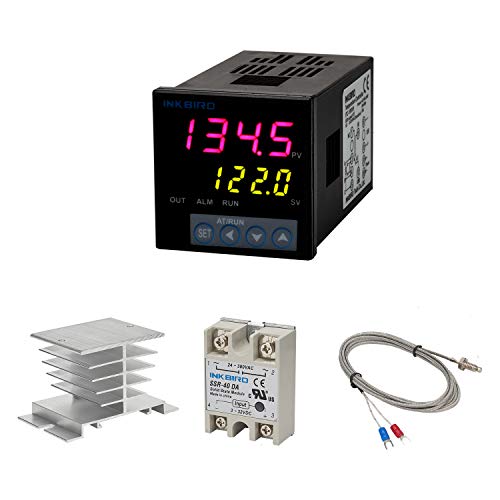
Inkbird PID Temperature Controller Kit
PID controller kit for driving an electric element, used on builds that control mash temperature directly.

Fermtech Fermentation Heating Belt
Electric warming belt sized for a carboy, jug or bucket.
Before you do this
Match a controller's rated outlet wattage to whatever is plugged into it; the 1100W-rated ITC-308 variant exists specifically because a compressor fridge or freezer can draw more than a standard controller's rated load. Overloading a controller's outlet is an electrical hazard, not just a warranty issue.
Related on BrewGearCalc
- Best fermenters for home brewing
- Best pressure fermenters
- Best brewing thermometers
- Yeast pitch calculator
- Reference
Frequently asked questions
- What temperature should I ferment ale yeast at?
- It depends entirely on the specific yeast strain, since each one has its own published fermentation range from the manufacturer, typically found on the packet or the manufacturer's product page. A controller does not set that range for a brewer; it just holds whatever target temperature the brewer chooses steady, whether that is on the cooler or warmer end of the strain's published range. Always check the specific strain's own listed range rather than a general rule.
- Do I need a dual-stage controller or will a single-stage one work?
- A single-stage controller only switches one device, usually a heat source, so it works fine in a space that only ever runs too cold. A dual-stage controller like the ITC-308 switches both a heater and a cooling device, such as a fridge or freezer, from one probe, which covers a room or a season that swings both warm and cold. Most home brewing spaces benefit from dual-stage control simply because indoor temperatures rarely stay in one direction year-round.
- Can I use a heating belt instead of a full temperature controller?
- Yes, if the only problem is a fermenter sitting somewhere too cold. A heating belt wraps around the vessel and adds gentle warmth, and pairing it with a simple controller or even a basic outlet timer can hold a workable range without a fridge conversion. It cannot cool anything down, so it is the wrong tool if the space also runs too warm during part of the year or during an active, heat-producing fermentation.
- Is a glycol chiller available for home brewers in this catalog?
- No. There is no true consumer glycol chiller, the closed-loop system that circulates chilled fluid through a coil around a fermenter, among the products in this catalog. The practical substitute most home brewers use is a dual-stage controller like the Inkbird ITC-308 paired with a chest freezer or a dedicated fermentation fridge, which holds standard ale and lager fermentation temperatures well without a dedicated glycol loop.
- Does a WiFi temperature controller ferment beer better than a wired one?
- No, a WiFi-enabled controller like the Inkbird WiFi ITC-308 controls temperature the same way as the standard wired version; the only difference is remote monitoring and alerts sent to a phone. That is a real convenience for a brewer who travels or works away from the fermentation space for long stretches, but it does not change how tightly or accurately the temperature itself is held during fermentation.
- What is the difference between the Inkbird ITC-308 and the ITC-608T?
- The ITC-308 reads temperature from a single probe, typically taped to the fermenter itself. The ITC-608T reads from two probes, which lets a brewer compare the beer's own temperature against the surrounding chamber air at the same time. That distinction is useful for temperature-sensitive styles or multiple fermenters sharing one chamber, but a brewer running one fermenter with one target temperature gets the same practical result from the cheaper single-probe ITC-308.
Researched from published brewing formulas, manufacturer specifications and verified owner reviews. This is general guidance, not professional advice.