Calculator
Boil-Off and Evaporation Rate Calculator
The one number that makes every other volume calculation on this site accurate for your system.
Boil-off depends on your burner, your kettle diameter and the humidity of the air, so a figure borrowed from someone else does not transfer. Measure it once at the same temperature at both ends, because hot wort occupies measurably more volume than cool wort and comparing a hot reading with a cold one invents evaporation that never happened.
The formula
Boil-off depends on your burner, your kettle diameter and the humidity of the air, so a figure borrowed from someone else does not transfer. Measure it once at the same temperature at both ends, because hot wort occupies measurably more volume than cool wort and comparing a hot reading with a cold one invents evaporation that never happened.
What rests on a standard and what rests on convention
- Standard Volume and gravity point arithmetic.
A standard is a published equation, a published constant or a manufacturer specification. A convention is widely repeated brewing practice with no governing document behind it. Both are useful. Confusing one for the other is how a habit ends up being quoted as a fact.
Kettles and systems
This grid re-orders itself against the numbers you enter above. Prices are those returned when the page was built and change often.
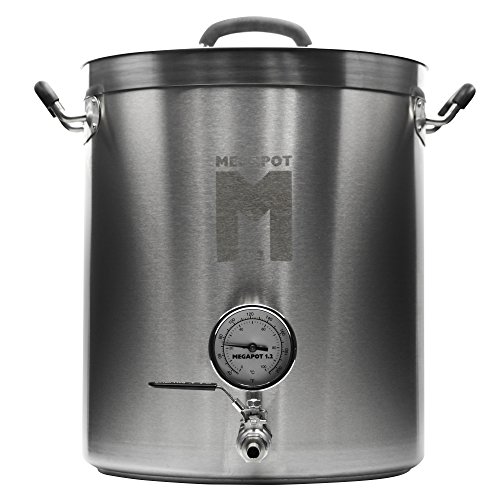
Northern Brewer MegaPot 10 Gallon (valve and thermometer)
Heavy stainless kettle with volume markings, a ball valve and a fitted thermometer, for propane or electric element brewing.

Northern Brewer MegaPot 10 Gallon (valve)
The same MegaPot body with a ball valve but no thermometer port fitted.

Concord 10 Gallon Brew Kettle (weldless fittings)
Forty quart stainless stock pot supplied with weldless valve and thermometer fittings.

MRbrew 10 Gallon Brew Kettle with Thermometer
Budget ten gallon stainless kettle with a built-in thermometer.
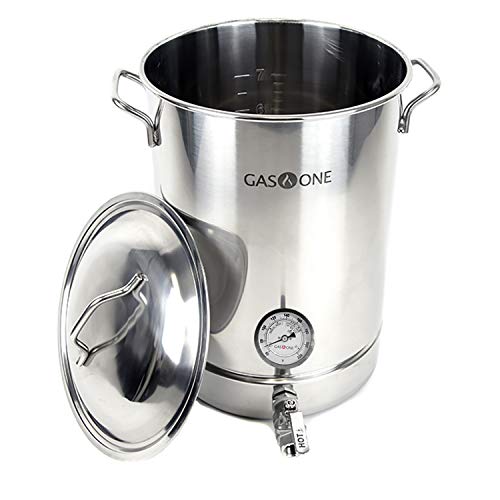
Gas One 8 Gallon Brew Kettle (4 piece set)
Pre-drilled 32 quart tri-ply bottom kettle sold as a four piece set.

VEVOR 16 Gallon Brew Kettle with Filter
Large stainless kettle with a filter and filter tube, for ten gallon batches on a burner.

BrewZilla Gen 4 (35L, 110V, with pump)
Wifi and RAPT integrated 35 litre all-in-one with a recirculation pump and automatic step mashing, on standard US household power.
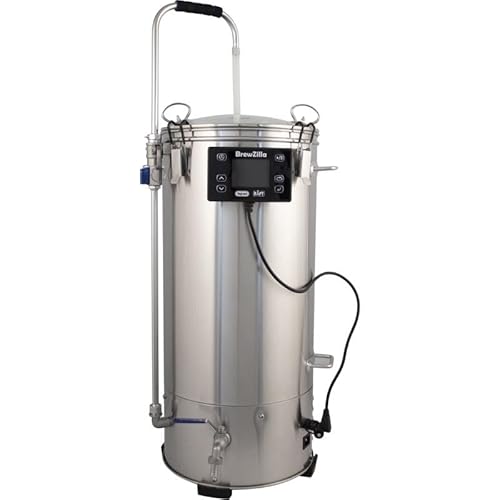
BrewZilla Gen 4 35L (110V)
The 110V Gen 4 BrewZilla: stainless construction, automatic step mashing, nine gallon capacity.

BrewZilla Gen 3.1.1 (35L)
The previous generation BrewZilla at a lower price, with the same 35 litre stainless body and step mashing.

Brewer's Edge Mash & Boil Series 2 with Pump
Programmable electric all-in-one kettle with a recirculation pump, sized for five gallon batches.

Brewer's Edge Mash & Boil Series 2 (no pump)
The same programmable all-in-one without the recirculation pump, which is the single cheapest way into all-grain electric brewing.
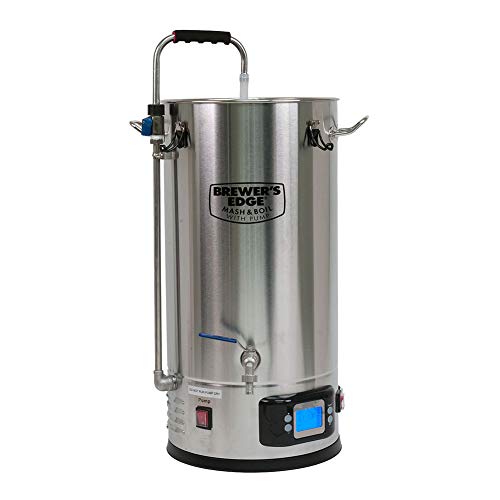
Brewer's Edge Mash and Boil with Pump (7.5 gal)
All-grain electric system with pump, 7.5 gallon capacity, no propane or separate mash tun required.

Brewer's Edge Mash and Boil
The original Mash and Boil, an electric mash tun and kettle in one vessel.

Grainfather G30 (3rd generation)
Stainless all-in-one with counterflow chilling and app control, aimed at brewers who want repeatable step mashes.
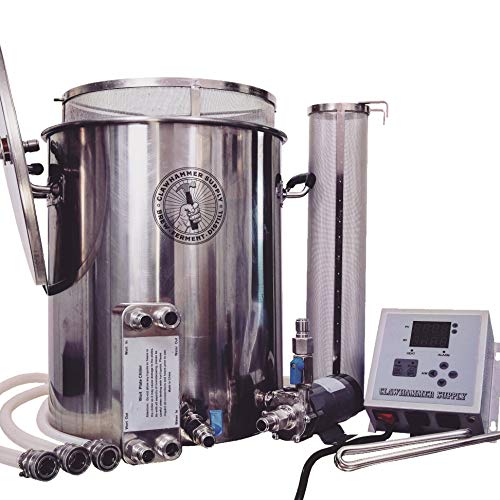
Clawhammer Supply 10.5 Gallon Electric System
Digital semi-automated 120V BIAB system with a 10.5 gallon kettle, the largest single-vessel option here.

VEVOR Electric Brewing System (9.2 gal)
Budget 35 litre all-in-one with pump, the cheapest route to a full electric mash and boil.
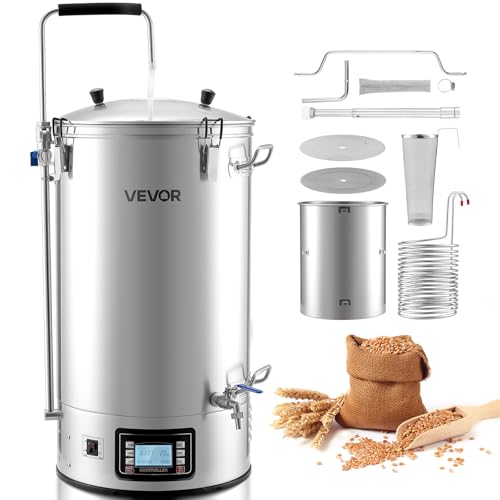
VEVOR 16 Gallon Brewing System (3000W)
Sixteen gallon all-in-one with anti-burn pump and wort chiller, sized for ten gallon batches.

VEVOR 8 Gallon Home Beer Brewer (1500W)
Eight gallon 304 stainless all-in-one, the smallest full electric system that still handles a five gallon batch.

FOHERE All-in-One Electric Brewing System (9.2 gal)
A 35 litre single-vessel electric system at entry pricing.
Related on BrewGearCalc
Frequently asked questions
- What is a normal boil-off rate?
- Most home systems lose somewhere around one to one and a half gallons per hour, but the spread is wide because it depends on kettle diameter and how hard you boil. A wide kettle with a vigorous boil evaporates far more than a narrow one at a gentle rolling boil. Measure yours rather than adopting a typical figure.
- Does a harder boil make better beer?
- Up to a point. You need enough turbulence for a good hot break and to drive off unwanted volatiles from pale malt, but beyond that a harder boil mostly costs you volume and darkens the wort. A steady rolling boil achieves what is needed without evaporating a gallon you then have to plan around.
- Why measure volume at the same temperature?
- Because water expands when heated. Hot wort occupies noticeably more volume than the same wort cooled, so comparing a hot pre-boil reading against a cool post-boil reading exaggerates your apparent evaporation. Take both readings at the same temperature, or correct for it, or the number you derive will be wrong every time you use it.
Researched from published brewing formulas, manufacturer specifications and verified owner reviews. This is general guidance, not professional advice.