Best Gear
Best All-Grain Brewing Systems
The BrewZilla Gen 4 (35L, 110V, with pump) is the best all-grain brewing system for most home brewers at $599.99, because it pairs a 35 liter full volume kettle with an integrated recirculation pump in one vessel.
Brewers on a tighter budget who still want a true all-grain mash and boil in one system can start with the Brewer's Edge Mash & Boil Series 2 at $369.95 and add a pump later if they decide they want one.

BrewZilla Gen 4 (35L, 110V, with pump)
Kegland
It is the only system in this catalog that combines a full volume 35 liter kettle, a digital controller and a built in recirculation pump in one 110V unit, so a single vessel covers mash and boil without extra plumbing.
Price last checked at publication and changes often.
What actually decides this purchase
An all-grain system has to do two jobs a partial mash or extract setup does not: hold and heat enough water to mash a full grain bill, then boil the resulting wort at a rolling boil for the length of the recipe. That means capacity is the first filter. A finished 5 gallon batch typically starts from a pre-boil volume noticeably larger than 5 gallons once you account for boil-off and grain absorption, so a kettle or all-in-one rated at 8 to 10 gallons is the realistic minimum for a standard batch, not a luxury.
The second decision is whether you want a pump. A pump lets you recirculate wort over the grain bed during the mash, which keeps mash temperature more even from top to bottom and speeds up the transition to boil. Without one, you stir by hand and drain by gravity or by lifting the vessel, which works fine but takes more attention and more physical effort on brew day.
The third decision is where the system lives. An all-in-one electric unit plugs into a wall outlet and can usually brew in a kitchen, garage or covered patio. A kettle-and-burner setup needs open air because it burns propane, and a separate mash tun and kettle combination needs more counter or floor space than a single vessel.
- Match rated capacity to your actual batch size, not the smallest number on the box.
- Decide if manual stirring and gravity draining is acceptable or if a pump is worth the extra cost.
- Confirm the system can run where you actually plan to brew, indoors or out.
- Look for an upgrade path: can you add a pump, a bigger kettle or a chiller later without replacing the whole system.
How we chose
Every system named here is compared using the manufacturer specifications published for that listing, such as stated capacity, voltage, wattage and whether a pump is included, along with verified purchase owner reviews on the retail listing itself. Nobody on this team ran these units side by side in a personal brew day test. The picks reflect what the manufacturers state a unit does and what verified owners consistently report after buying and using one, not hands on testing performed for this article.
How the options compare
Prices in this catalog run from $149.90 for the smallest electric pot to $1,499.00 for the largest all-in-one. The table below lists capacity and price exactly as published, so you can see where the jump from a bare pot to a pump equipped system actually happens.
| System | Capacity | Pump included | Price |
|---|---|---|---|
| VEVOR 8 Gallon Home Beer Brewer (1500W) | 8 gal | No | $149.90 |
| FOHERE All-in-One Electric Brewing System | 9.2 gal | No | $219.99 |
| BrewZilla Gen 3.1.1 | 35L | No | $469.95 |
| BrewZilla Gen 4 (110V, with pump) | 35L | Yes | $599.99 |
| VEVOR 16 Gallon Brewing System (3000W) | 16 gal | No | $273.30 |
| Clawhammer Supply 10.5 Gallon Electric System | 10.5 gal | No | $1,499.00 |
Matching a system to how much you brew
For a first all-grain batch, the Brewer's Edge Mash & Boil Series 2 at $369.95 is a reasonable starting point. It has no pump, so you stir the mash by hand and drain by opening the built in valve, but it removes the need to juggle a separate mash tun and kettle while you learn the process.
Once you know you will keep brewing all-grain, the BrewZilla Gen 3.1.1 at $469.95 adds a digital controller and the same 35 liter full volume capacity as the Gen 4, without the added cost of the pump. It is a step up in control without a step up in complexity, which makes it a fair middle ground for someone who has already brewed a handful of all-grain batches.
At the top end, the Clawhammer Supply 10.5 Gallon Electric System at $1,499.00 is built for brewers who consistently push past a standard 5 gallon finished batch, whether that means 10 gallon batches or two 5 gallon batches back to back on the same brew day. Brewers who only ever brew 5 gallons at a time should not buy this system. The extra capacity and the price that comes with it go unused, and a smaller pump equipped unit like the Gen 4 does the same job for less money.
Where an all-in-one system can fall short
Even the largest all-in-one in this catalog tops out well short of what a dedicated brewery setup can do, so if your ambitions run past 10 to 12 gallons finished, you are looking at a different category of equipment entirely, not a bigger version of these units.
An all-in-one also only replaces the mash and boil vessel. You still need separate fermentation, chilling and packaging gear regardless of which system you buy, so the sticker price on the system itself is not the full cost of getting from grain to glass.
Some brewers choose to skip an all-in-one entirely and build their own setup from a standalone kettle, a cooler based mash tun and a burner. That path is covered in our brew kettle and mash tun roundups. If that is the direction you take and you use a propane burner instead of an electric heating element, keep it outdoors only. Propane combustion produces carbon monoxide, and that gas has no smell to warn you it is building up in an enclosed space like a garage or basement.
Getting the most out of whichever system you pick
The system does not determine your efficiency by itself. Your crush, your water chemistry and your mash technique matter just as much, whether you are mashing in a $150 pot or a $1,499 all-in-one. A commonly used target for home brewers is 72 to 75 percent mash efficiency, which is a widely repeated shop convention rather than a published physical constant, so treat it as a benchmark to compare your own results against, not a guarantee.
Before brew day, run your recipe through our strike water calculator and mash water calculator so you know how much water to heat and to how many degrees for the system's actual volume, and check expected efficiency with our efficiency calculator once you have a few batches of data to compare. A hydrometer reading of stable gravity across a few days is still the only real confirmation that fermentation has finished, regardless of what system produced the wort.
Common mistakes when buying an all-grain system
The most common sizing mistake is buying a system rated at exactly your target finished volume rather than above it. A system marketed around an 8 to 10 gallon capacity is describing the vessel's total volume, not the volume left over once you account for grain absorption, boil-off and a margin for a vigorous boil, so a system sized right at the edge of your batch leaves little room for error on brew day.
A second common mistake is assuming a pump equipped system removes the need to pay attention during the mash. A pump helps keep temperature even and speeds up recirculation, but it does not replace checking your actual mash temperature with a thermometer or watching for a stuck recirculation if grain husks pack down against an intake screen.
A third mistake is treating the system's price as the full budget for going all-grain. A mill, a way to weigh grain, a fermenter, a chiller and packaging gear are all separate purchases regardless of which all-in-one or standalone kettle you buy, so it helps to budget for the whole setup rather than just the mash and boil vessel.
The three tiers
These are three genuinely different builds, not the same product at three prices. Buy the tier that matches how much you already know you will use it.
Brewer's Edge Mash & Boil Series 2 (no pump)
Brewers Edge
No pump keeps the learning curve simple: you mash, stir by hand, and drain through the built in valve. It costs $369.95, which is less than any pump equipped option, at the cost of manual recirculation.
$369.95
View on AmazonBrewZilla Gen 3.1.1 (35L)
Kegland
The same 35 liter full volume capacity as the Gen 4 with a digital controller, at $469.95, without paying for the pump if you are not yet ready to use one.
$469.95
View on AmazonClawhammer Supply 10.5 Gallon Electric System
Clawhammer Supply
At $1,499.00 and 10.5 gallon capacity, this is built for brewers who regularly exceed a standard 5 gallon finished batch. Brewers who only ever brew 5 gallons at a time should not buy this: the extra capacity and cost go unused.
$1,499.00
View on AmazonEverything else worth considering

Brewer's Edge Mash & Boil Series 2 with Pump
Programmable electric all-in-one kettle with a recirculation pump, sized for five gallon batches.

VEVOR Electric Brewing System (9.2 gal)
Budget 35 litre all-in-one with pump, the cheapest route to a full electric mash and boil.

VEVOR 8 Gallon Home Beer Brewer (1500W)
Eight gallon 304 stainless all-in-one, the smallest full electric system that still handles a five gallon batch.

FOHERE All-in-One Electric Brewing System (9.2 gal)
A 35 litre single-vessel electric system at entry pricing.
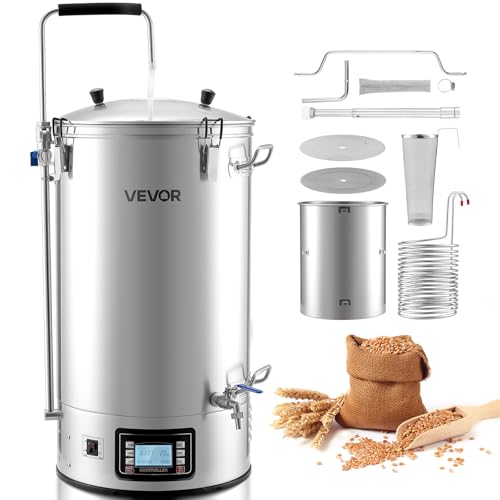
VEVOR 16 Gallon Brewing System (3000W)
Sixteen gallon all-in-one with anti-burn pump and wort chiller, sized for ten gallon batches.
Before you do this
If you build an all-grain setup around a standalone kettle and a propane burner instead of an electric all-in-one, keep the burner outdoors only. Propane combustion produces carbon monoxide, which has no smell and can build up unnoticed in a garage or basement.
Related on BrewGearCalc
- Strike water calculator
- Mash water calculator
- Efficiency calculator
- Best mash tuns
- Best brew kettles
- Brewing guides
Frequently asked questions
- Do I need a pump for all-grain brewing?
- No. A pump recirculates wort over the grain bed for more even mash temperatures and a faster transition to boil, but plenty of home brewers mash and sparge by hand with good results. If you are brewing your first few all-grain batches, a no-pump system like the Brewer's Edge Mash & Boil Series 2 removes one variable while you learn the process, and you can move to a pump equipped system later once you know you want one.
- What size all-grain system do I actually need for a 5 gallon batch?
- Look for a system rated at 8 to 10 gallons or more, since a 5 gallon finished batch starts from a larger pre-boil volume once you account for boil-off and the water grain absorbs. A system that is only just large enough for 5 gallons finished can boil over or leave no headroom for a vigorous boil, so sizing up slightly gives you a margin of safety on brew day.
- Can I use an all-grain system indoors?
- Electric all-in-one systems in this catalog run on standard household power and can be used indoors, in a kitchen or garage, as long as the space has adequate ventilation for the steam a boil produces. A propane fired kettle and burner setup must stay outdoors, since burning propane produces carbon monoxide, which has no smell to warn you it is accumulating in an enclosed space.
- Is a more expensive all-grain system actually better, or just bigger?
- Price in this catalog mostly tracks capacity and features like a pump or a digital controller, not a difference in the beer quality you can produce. A $369.95 system and a $1,499.00 system can both make excellent beer; the expensive one is built for brewing more volume, more often, or with less manual attention on brew day, not for making a better recipe by itself.
- What is the difference between BrewZilla Gen 3.1.1 and Gen 4?
- Based on the published listings, both are 35 liter full volume all-in-one systems with a digital controller. The Gen 4 adds a built in recirculation pump and is sold at $599.99, while the Gen 3.1.1 does not include a pump and is sold at $469.95. If you already know you want to recirculate during the mash, the Gen 4 saves you from sourcing a separate pump.
- Do I still need a separate fermenter if I buy an all-in-one system?
- Yes. An all-in-one all-grain system replaces your mash tun, kettle and sometimes a wort chiller connection point, but it is not a fermenter. You still need a bucket, carboy or conical fermenter with a working airlock, plus a way to package the finished beer, regardless of which mash and boil system you choose.
Researched from published brewing formulas, manufacturer specifications and verified owner reviews. This is general guidance, not professional advice.