Calculator
Brewhouse Efficiency Calculator
Stop assuming an efficiency figure and measure the one your system really gives.
This is the number to use in every future recipe instead of a borrowed assumption. Measure gravity and volume at the same point in the process every time, because efficiency quoted at the fermenter and efficiency quoted into the kettle are different numbers and mixing them up makes recipes drift.
The formula
This is the number to use in every future recipe instead of a borrowed assumption. Measure gravity and volume at the same point in the process every time, because efficiency quoted at the fermenter and efficiency quoted into the kettle are different numbers and mixing them up makes recipes drift.
What rests on a standard and what rests on convention
- Standard The arithmetic, and published malt potential.
A standard is a published equation, a published constant or a manufacturer specification. A convention is widely repeated brewing practice with no governing document behind it. Both are useful. Confusing one for the other is how a habit ends up being quoted as a fact.
Mills and gravity gear
This grid re-orders itself against the numbers you enter above. Prices are those returned when the page was built and change often.
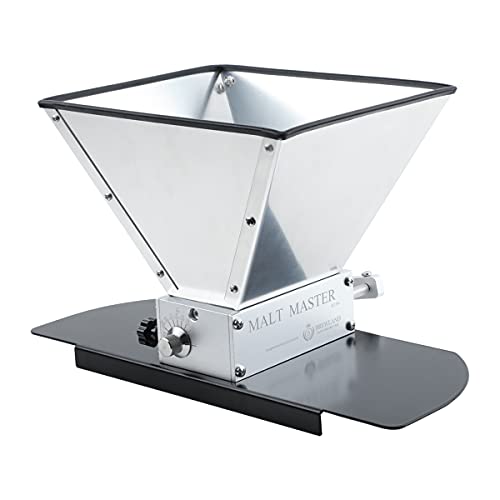
Brewland 2 Roller Grain Mill with Hopper
Adjustable two roller malt mill, which lets you crush your own grain and control efficiency directly.

Ferroday 2 Roller Stainless Grain Mill
Two roller stainless malt mill at entry pricing.

Brewland Grain Mill Pro (3 roller, 13 lb hopper)
Three roller mill on a steel base with a thirteen pound hopper, for brewers milling large grain bills.
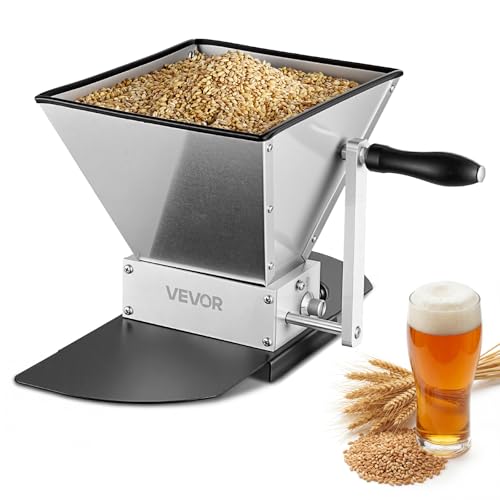
VEVOR Manual Grain Mill
Adjustable manual barley crusher for homebrew malt.

Brewer's Elite Hydrometer and Test Jar
Triple scale hydrometer with a plastic test jar. Stable gravity on this instrument is the only real proof fermentation has finished.
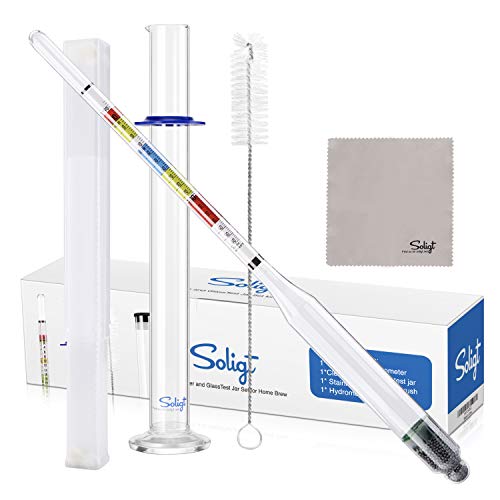
SOLIGT Triple Scale Hydrometer with Glass Test Jar
Hydrometer reading ABV, Brix and specific gravity, supplied with a glass jar.
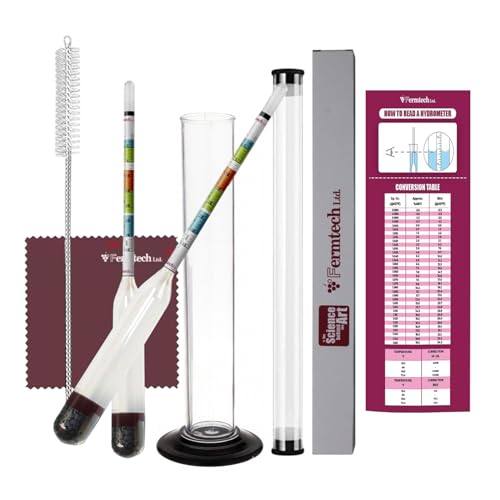
Fermtech Glass Triple Scale Hydrometer Kit
Triple scale glass hydrometer for beer, wine, mead and cider.

Fermentaholics Hydrometer Test Jar
Measuring cylinder for taking a gravity sample without dropping the hydrometer into the fermenter.

Brewing America Glass Hydrometer Test Jar with Brush
Narrow glass flask and cleaning brush, which reads more accurately than a wide vessel.
Related on BrewGearCalc
Frequently asked questions
- What is a good brewhouse efficiency?
- Most home systems land somewhere between 65 and 80 percent, and consistency matters far more than the absolute figure. An efficiency of 65 percent that you hit every time is more useful than 80 percent that swings by ten points, because recipes built on a stable number come out as designed.
- How do I improve efficiency?
- Start with the crush, which dominates everything else. A tighter mill gap exposes more starch. After that, make sure the mash holds its temperature for the full rest, sparge slowly enough to actually rinse the grain, and check that you are measuring volume accurately. A misread volume shows up as an efficiency problem that does not exist.
- Why does my efficiency drop on big beers?
- Larger grain bills sparge less effectively, because there is more grain to rinse with proportionally less water and the sugar concentration stays high. Efficiency falling on high gravity batches is normal and expected. Plan for it by assuming a lower figure on big beers rather than being surprised by a missed target.
Researched from published brewing formulas, manufacturer specifications and verified owner reviews. This is general guidance, not professional advice.