Calculator
Water Chemistry Salt Addition Calculator
Ion contributions follow from the chemistry. What they taste like is a different kind of claim.
Those ion contributions follow directly from the molar masses of the salts, so they are standard. What is NOT standard is the interpretation: the idea that a high sulfate to chloride ratio sharpens hop character while a low one rounds out malt is brewing convention, not chemistry. Start from a water report if you have one. Chalk is deliberately absent from this calculator because it barely dissolves in water, so a calculator that credits its full ion contribution would be telling you something untrue.
The formula
Those ion contributions follow directly from the molar masses of the salts, so they are standard. What is NOT standard is the interpretation: the idea that a high sulfate to chloride ratio sharpens hop character while a low one rounds out malt is brewing convention, not chemistry. Start from a water report if you have one. Chalk is deliberately absent from this calculator because it barely dissolves in water, so a calculator that credits its full ion contribution would be telling you something untrue.
What rests on a standard and what rests on convention
- Standard Ion contributions follow from the molar masses of the salts.
- Convention The sulfate to chloride ratio as a flavour guide.
A standard is a published equation, a published constant or a manufacturer specification. A convention is widely repeated brewing practice with no governing document behind it. Both are useful. Confusing one for the other is how a habit ends up being quoted as a fact.
Before you do this
Treat brewing salts as chemicals. Use food grade products, weigh them on a scale that reads to a hundredth of a gram, and keep them clearly labelled and away from children.
Brewing salts and water testing
This grid re-orders itself against the numbers you enter above. Prices are those returned when the page was built and change often.

Craft A Brew Gypsum (calcium sulfate, 4 oz)
Calcium sulfate, which raises calcium and sulfate and is the salt used to sharpen hop bitterness.

LD Carlson Gypsum (1 lb)
One pound of brewing gypsum, which at typical dose rates lasts years.

Craft A Brew Calcium Chloride (4 oz)
Calcium chloride, which raises calcium and chloride and is the salt associated with a rounder, fuller palate.

Home Brew Ohio Calcium Chloride (1 lb)
Bulk calcium chloride for brewers adjusting every batch.

TAPCRAFT Brewing Salts Set
A set of the common brewing salts for building regional water profiles from a single purchase.

TAPCRAFT Campden Tablets (potassium metabisulfite, 50 count)
Removes chlorine and chloramine from tap water, which otherwise produce a medicinal off flavour.

BSG HandCraft Potassium Metabisulfite Tablets (2 oz)
Potassium metabisulfite tablets for dechlorinating brewing water.

LD Carlson Potassium Metabisulfite (2 oz)
Loose potassium metabisulfite for water treatment and, in cider making, for knocking back wild yeast.
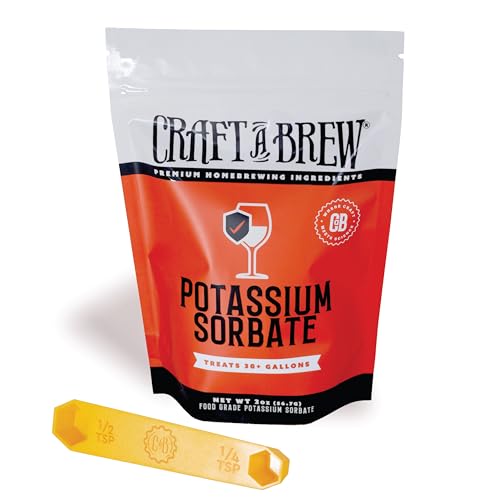
Craft A Brew Potassium Sorbate (2 oz)
Stabiliser used when back-sweetening cider or mead, which prevents the new sugar refermenting in the bottle.

YINMIK Digital pH Meter with ATC
Pocket pH meter with automatic temperature compensation for checking mash pH. It must be calibrated against buffer solutions to mean anything.

Anton Paar pH2Go Digital pH Meter
Glass-free ISFET sensor with guided calibration, far beyond what most home brewers need.

Digital Pocket Scale 200 g x 0.01 g
Hundredth of a gram resolution, which is the precision hop additions and water salts actually need.

BOMATA 1 kg x 0.01 g Digital Scale
Wider range 0.01 g scale, which covers both salt additions and whole hop packets.

Bonvoisin Digital Lab Scale 600 g x 0.01 g
Laboratory balance with a draft shield style body, for brewers building water profiles by the tenth of a gram.
Related on BrewGearCalc
Frequently asked questions
- Do I need to treat my water at all?
- Many brewers make good beer without ever adjusting water beyond removing chlorine. Dechlorinating is the one step that is nearly always worth it, because chlorine and chloramine produce a distinctly medicinal off flavour. Mineral adjustment beyond that is refinement, and it only pays off once your process is otherwise consistent.
- What is the sulfate to chloride ratio supposed to do?
- The convention holds that sulfate accentuates hop bitterness and makes it feel drier, while chloride emphasises malt and a fuller mouthfeel. It is a useful rule of thumb and many brewers find it holds. It is not a measured standard, so treat it as a direction to experiment in rather than a target to hit precisely.
- Why is chalk not in this calculator?
- Because chalk is very poorly soluble in water and mostly does not dissolve. A calculator that credited its full theoretical ion contribution would report calcium and bicarbonate that never actually entered your water, which is worse than offering nothing. If you need to raise alkalinity, baking soda genuinely dissolves and is included here.
Researched from published brewing formulas, manufacturer specifications and verified owner reviews. This is general guidance, not professional advice.