Compare
Kegerator vs Conversion Kit
A kegerator is a complete refrigerated appliance, ranging from $509.90 for the VEVOR Single Tap Kegerator up to $912.54 for the Kegco Dual Tap Stainless Kegerator in this catalog, ready to plug in and pour from day one. A conversion kit is only a tower, lines, and a regulator, priced from $105.90 to $305.00 here, and it requires a refrigerator or freezer you already own to actually work.
The kit is the better buy only when that fridge or freezer is already sitting unused, since its low sticker price is misleading otherwise: a kegerator's price already includes the refrigeration a kit assumes you have for free.

VEVOR Single Tap Kegerator (full size)
VEVOR
As a complete refrigerated appliance it does not require already owning a suitable fridge or freezer, which is the situation most first-time kegging setups are actually in.
Price last checked at publication and changes often.
The one distinction that decides this purchase entirely
A kegerator is a complete refrigerated appliance: compressor, insulated cabinet, and a pre-installed tower and tap, all built to hold one or more full-size kegs at pouring temperature. In this catalog that runs from $509.90 for a single tap model up to $912.54 for a dual tap stainless unit.
A conversion kit is a tower, beer lines, and a regulator only, priced from $105.90 to $305.00 here, and it requires a refrigerator or freezer you already own. It contains no refrigeration of its own at all. Comparing a kit's price directly against a kegerator's price without accounting for that missing refrigeration is the single most common mistake in this decision.
What's actually inside a conversion kit
A typical conversion kit includes a tower that mounts through a drilled hole in a lid or door, a faucet, beer line and gas line, and a CO2 regulator. Most listings, like the BACOENG Standard Tower Conversion Kit, explicitly do not include a CO2 tank, which means that piece has to be bought separately unless a specific kit bundles one, as the Kegco Standard Tower Conversion Kit does with its included 5 lb tank.
Door-mount kits exist for setups where drilling through a lid is not practical, mounting the tower and faucet through a freezer door instead. Either style still needs a suitable, working fridge or freezer underneath it before any of it does anything.
What's actually inside a complete kegerator
A complete kegerator arrives with its refrigeration already sized and insulated for one, two, or three full-size kegs, a tower and tap already installed rather than drilled in by the owner, and, on some models, a built-in thermostat tuned for beer serving temperature rather than a general refrigerator's range. A CO2 tank and regulator are still typically a separate purchase even with a complete kegerator, since the appliance itself is the refrigeration and dispensing hardware, not the gas system.
The dual and triple tap models in this catalog step up cabinet size and tower width to fit more kegs side by side, at a proportionally higher price than the single tap models.
When the kit is genuinely the better buy
A conversion kit only makes financial sense when a suitable refrigerator or freezer already exists and is sitting unused. A chest freezer is the most common candidate, since chest freezers are inexpensive and roomy relative to their price, but a standard chest freezer is calibrated for deep-freeze temperatures, well below what beer needs for serving, not the narrower range a kegerator holds. Converting a chest freezer for kegging commonly means adding a separate external temperature controller, such as the Inkbird ITC-308 Freezer and Fermentation Thermostat, since the freezer's own thermostat is not built for that range.
Once that fridge or freezer, and in many cases a temperature controller, are already accounted for, a kit's lower sticker price genuinely reflects real savings over buying a complete kegerator.
When the complete kegerator is the better buy
Anyone without a spare fridge or chest freezer sitting around is choosing between buying one separately to pair with a kit, or buying a kegerator that already includes it. In that situation, a kegerator's higher sticker price reflects real refrigeration hardware a kit assumes you already have, not an inflated markup over the same set of parts.
A complete kegerator also arrives with its tower already installed rather than requiring the owner to drill through a lid or door, which is a real, if smaller, consideration for anyone who would rather not modify a chest freezer they might want to resell someday in its original condition.
Single, dual, and triple tap decisions apply to both
Regardless of whether the refrigeration comes from a kit or a complete kegerator, the number of taps determines how many kegs can pour at once, and a shared single-body regulator delivers the same CO2 pressure to every keg connected to it. That works fine when every keg on tap wants the same carbonation level, but it does not work well when two beers need different pressures. A dual-body regulator, like the SPARC Premium Dual CO2 Regulator, gives each connected keg its own independent pressure setting instead.
This decision is identical whether the taps live on a drilled kit tower or a factory-installed kegerator tower; the regulator, not the refrigeration, is what actually controls it.
Working through the total cost, not just the sticker price
A conversion kit's own price, from $105.90 to $305.00 in this catalog, only tells part of the story for anyone starting from zero. Add the real cost of a suitable fridge or freezer, plus a temperature controller if converting a standard chest freezer, plus a CO2 tank if the specific kit does not already include one, and the total can land close to, or above, what a complete kegerator costs outright.
For someone who already owns a spare chest freezer doing nothing else, none of those extra costs apply, and the kit's low sticker price is the real total cost of getting into kegging. That single fact, whether a suitable fridge or freezer is already sitting unused, is what the entire decision actually hinges on.
Maintenance differences worth knowing before buying
A complete kegerator's refrigeration is a sealed appliance system, which means a compressor failure is a warranty or repair issue with the unit as a whole rather than something easily swapped out at home. A converted chest freezer keeps its own separate, often older and simpler, refrigeration system, which can be easier and cheaper to service or eventually replace on its own, independent of the tower and tap hardware mounted to it.
Beer lines, faucets, and CO2 hardware need the same periodic cleaning routine regardless of which refrigeration path was chosen, since none of that hardware differs between a kit and a factory-installed kegerator tower.
How the options compare
| Feature | Kegerator | Conversion kit |
|---|---|---|
| Includes refrigeration | Yes | No, requires an existing fridge or freezer |
| Includes tower, lines, regulator | Yes, pre-installed | Yes, as the entire product |
| Price range in this catalog | $509.90 to $912.54 | $105.90 to $305.00 |
| May need a separate temperature controller | Not usually, on built-in models | Often, if converting a standard chest freezer |
| Best for | No existing fridge or freezer to convert | An already-owned, suitable fridge or freezer |
Cleaning routines are identical either way
Beer lines, faucets, and the inside of a keg all need periodic cleaning regardless of whether the surrounding refrigeration came from a kit installed on an existing freezer or a factory-built kegerator. A pressurized keg cleaning kit or a quick-connect line cleaning kit flushes cleaning solution directly through the same lines beer travels through, and that routine does not change based on where the tower is mounted.
A dirty beer line is a common, overlooked source of off flavors and pour problems that has nothing to do with whether the setup is a kit or a complete kegerator, which is worth remembering before assuming a hardware upgrade will fix a pour quality issue that a cleaning pass would actually solve.
What to check before buying a conversion kit for a specific fridge
A keg with its coupler attached needs real interior height to stand upright, and a refrigerator's door shelves, interior lip, or a compressor housing that intrudes into the cabinet floor can quietly rule out a fridge that looks roomy at a glance. Measuring the actual usable interior height and width before ordering a kit avoids the frustration of a tower and regulator that arrive with nowhere to put the keg underneath them.
Drilling through a lid or door for a tower is permanent, and on a shared or rented appliance that is worth confirming is acceptable before committing to that style of kit over a door-mount alternative. Planning where the CO2 tank itself will sit, whether inside the cabinet alongside the keg or outside it connected by a longer gas line, is also worth deciding before the kit arrives rather than improvising afterward.
How we chose
These picks come from published capacity specifications, tower and tap configurations, and included-versus-separate CO2 hardware, along with verified owner reviews on build quality and temperature consistency. This is not the result of personal hands-on kegging with these specific units. Listings that were ambiguous about whether a CO2 tank was included were checked carefully rather than assumed either way.
The three tiers
These are three genuinely different builds, not the same product at three prices. Buy the tier that matches how much you already know you will use it.
VEVOR Single Tap Kegerator (full size)
VEVOR
At $509.90 it is a complete single tap appliance that doesn't require already owning a suitable fridge, the default starting point for most first-time kegging setups.
$509.90
View on AmazonVEVOR Single Tap Kegerator Tower Conversion Kit
VEVOR
At $105.90 it is the cheapest way into kegging, but only for someone who already has a suitable fridge or freezer sitting unused; without one, its low price does not reflect the real total cost.
$105.90
View on AmazonKegco 24 inch Dual Tap Stainless Kegerator
Kegco
At $912.54 it pours two beers at once from a single stainless appliance with no drilling or separate fridge to source. Anyone who already owns a suitable fridge or freezer should not buy this; paying for built-in refrigeration duplicates equipment they already have, and it's also overkill for someone who only ever pours one beer at a time.
$912.54
View on AmazonEverything else worth considering

VEVOR Dual Tap Kegerator (full size, D system)
Full size dual tap kegerator with shelving, which pours two beers cold without any conversion work.

BACOENG Standard Tower Conversion Kit (no tank)
Conversion kit only. It needs a suitable refrigerator and a CO2 tank, neither of which is included.
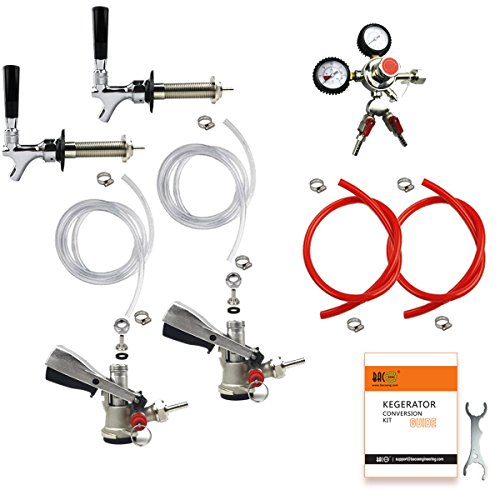
BACOENG Double Faucet Door Mount Conversion Kit
Door mounted twin faucet conversion kit, which keeps the fridge top clear. No tank.

Kegco Standard Tower Conversion Kit with 5 lb CO2 Tank
A CONVERSION kit, not a kegerator: tower, lines, regulator and a CO2 tank to fit a fridge you already own.

Kegco Elite Series Dual Tap Conversion Kit
Commercial grade dual tap conversion kit for a fridge you supply.

Inkbird ITC-308 Freezer and Fermentation Thermostat
Plug-in heating and cooling controller for converting a chest freezer into a fermentation chamber.

SPARC Premium Dual CO2 Regulator
Two output CO2 regulator, which lets you hold two kegs at different pressures from one tank.
Before you do this
A CO2 cylinder is a high pressure vessel. Secure it upright at all times, never modify a valve or regulator, and have cylinders filled or exchanged only through a qualified supplier.
Related on BrewGearCalc
Frequently asked questions
- Can I convert any chest freezer into a kegerator with a conversion kit?
- Most chest freezers can be converted, but a standard chest freezer's built-in thermostat is calibrated for deep-freeze temperatures, well colder than beer needs for serving. Converting one for kegging usually means adding a separate external temperature controller, like the Inkbird ITC-308 Freezer and Fermentation Thermostat, in addition to the tower, lines, and regulator that come in the conversion kit itself.
- Is a conversion kit actually cheaper than a kegerator?
- Only if you already own a suitable fridge or freezer. A kit's lower sticker price reflects the fact that it includes no refrigeration at all. Someone without a spare fridge who buys a kit still has to source refrigeration separately, at which point the total cost can approach or exceed a complete kegerator's price for the same end result.
- Do I need a separate CO2 tank for a kegerator or a conversion kit?
- Usually yes for either one. Most kegerators and most conversion kits in this catalog include the tower, lines, and regulator but not a CO2 tank, with a few exceptions like the Kegco Standard Tower Conversion Kit that bundles a 5 lb tank. Check a specific listing carefully rather than assuming a tank is included.
- How many taps do I actually need?
- That depends on how many beers you want available to pour at the same time, not on how many kegs you own overall, since extra kegs can simply be swapped onto an existing tap. If two beers on tap at once need different carbonation levels, a dual-body regulator that gives each keg independent pressure matters more than the number of faucets itself.
- Can I add a second tap to a single tap kegerator later?
- It depends on the cabinet's internal space for a second keg and whether the existing tower supports adding a faucet, which varies by model and is not something every single tap kegerator is designed for. In many cases it is simpler to plan for the number of taps needed up front than to modify a single tap unit afterward.
- Does a conversion kit require drilling into my freezer?
- A standard tower conversion kit does require drilling through the lid to mount the tower, which is a real, permanent modification to the freezer. A door-mount style kit avoids drilling through the lid by mounting through the door instead, which is worth considering for anyone who wants to keep a chest freezer closer to its original condition.
Researched from published brewing formulas, manufacturer specifications and verified owner reviews. This is general guidance, not professional advice.