Compare
Stainless vs Plastic Fermenters
For a standard five gallon batch, a plastic bucket like the FastRack 6.5 Gallon Fermenting Bucket at $31.95 ferments beer just as well as stainless steel, since fermentation quality depends on temperature and yeast health, not the material of the vessel wall.
Stainless earns its higher price through durability over years of reuse, resistance to scratching and odor retention, and features like drain valves that most plastic vessels do not have.

U.S. Solid 6.5 Gallon Fermenter with Airlock and Spigot
U.S. Solid
It ferments beer identically to a stainless conical costing several times more, and its built-in spigot gives you one real convenience of stainless, easier racking, without the added cost or weight.
Price last checked at publication and changes often.
What actually differs between stainless and plastic
Stainless steel does not scratch under normal cleaning, does not absorb odor from a previous batch, and can be welded into shapes plastic cannot, like a cone bottom with a drain valve. Food grade plastic, whether a straight sided bucket or a wide mouth PET vessel, is lighter, cheaper to manufacture, and just as capable of holding beer safely through fermentation. Neither material changes how yeast behaves inside the vessel.
The practical differences show up in three places: how the vessel handles years of repeated use, how easy it is to drain trub or yeast without opening the lid, and how much a full vessel weighs when you need to move it.
Where stainless earns its price
A scratch in plastic is a place for microbes to hide that a normal cleaning and sanitising routine may not fully reach, and enough scratches over years of reuse can eventually push a plastic vessel toward retirement. Stainless does not develop that problem the same way; a properly cleaned stainless vessel can be reused for a very long time without that concern building up. Stainless conicals like the Fermtech 6 Gallon Conical Fermenter at $219.00 and stainless straight sided vessels like the VEVOR 8 Gallon Stainless Brew Bucket at $140.90 also hold their shape and resist denting far better than plastic holds up to a hard knock.
Stainless conical shapes add the drain valve advantage covered in more detail in our conical versus bucket comparison: draining trub or yeast without opening the fermenter lowers infection risk during that specific step.
Where plastic is genuinely the smarter buy
For a brewer replacing fermenters every few years anyway, or buying a first fermenter at all, plastic buckets cost a fraction of stainless and ferment beer to the same standard. The FastRack 6.5 Gallon Fermenting Bucket at $31.95 and the U.S. Solid 6.5 Gallon Fermenter with Airlock and Spigot at $47.57 both handle a standard batch completely, and plastic is also lighter to lift and carry full, which matters more than most new brewers expect the first time they move a full fermenter across a kitchen.
Plastic buckets are also more forgiving of a hard bump. A dropped stainless vessel can dent; a dropped plastic bucket almost never cracks outright, though a hard enough impact can still stress the plastic over time.
Headspace and capacity apply to both materials equally
Whichever material you choose, size for roughly 6.5 gallons of capacity to ferment a standard five gallon batch, leaving room for krausen to rise without pushing up the airlock. This is a vessel sizing question, not a material question, and it applies the same way to the stainless conicals and plastic buckets in this catalog.
Cleaning stainless versus plastic in practice
Stainless steel tolerates a wider range of cleaners without any real risk to the vessel itself; a caustic cleaner like PBW, an acid based cleaner or a stronger scrub than plastic can comfortably take are all fine on stainless as long as you follow the cleaner's own directions. Plastic is more sensitive to abrasive scrubbing specifically, since abrasion is what creates the scratches that eventually retire a plastic vessel from service.
In daily practice this means a stainless vessel forgives a slightly rougher cleaning routine, while a plastic vessel rewards a soft cloth or a soft bristle brush and a cleaner that does its job through chemistry rather than scrubbing pressure. Neither approach is difficult, but the plastic routine asks a little more discipline from the person doing the cleaning.
Denting, dropping and what happens after an accident
A stainless vessel that takes a hard knock can dent, and a dent near a weld seam or a valve fitting is worth inspecting closely, since a compromised seam can eventually leak. A dent that is purely cosmetic, away from any seam or fitting, generally does not affect function at all.
A plastic bucket that takes the same hard knock almost never dents in a way that matters; it flexes and returns to shape far more often than it cracks. The exception is a genuinely sharp impact, a corner or an edge rather than a flat drop, which can crack plastic outright in a way a dent in stainless simply does not compare to. For a fermenter that gets carried up and down stairs regularly, that difference in how each material fails is worth thinking about before buying.
The full cost of ownership beyond the purchase price
A stainless vessel's higher purchase price is mostly a one-time cost; once bought, a well cared for stainless fermenter rarely needs replacing, and cleaning it well takes roughly the same time and effort batch after batch for years. A plastic bucket's lower purchase price is not quite as final: expect to replace a heavily used bucket every several years as scratching accumulates, which is a real recurring cost even though each individual bucket is inexpensive.
Storage is similar for both, since both need to stand upright with the lid or a cover in place between batches, though a stainless conical's cone bottom and any attached fittings mean it generally cannot be nested or stacked the way an empty plastic bucket can, which matters if storage space is tight.
What the choice locks you into
A stainless vessel with a fixed capacity, say a 6 gallon conical, caps your batch size at that number without an easy workaround; brewing a bigger batch means buying a second, larger stainless vessel, which is a meaningful expense given the pricing in this catalog. A plastic bucket has the same ceiling in principle, but replacing one with a slightly bigger bucket is a much smaller financial decision, which makes plastic the more flexible choice for a brewer whose batch sizes might still change.
The conical shape itself, whichever material it is made from, is also a one-way commitment in terms of workflow: once you are used to draining trub and harvesting yeast through a bottom valve, a straight sided vessel of either material feels like a step backward for that specific task, regardless of whether it is stainless or plastic.
Resale value, if you ever sell your gear
Stainless equipment tends to hold resale value better than plastic in the secondhand homebrew market, partly because buyers trust that a stainless vessel without visible damage is functionally as good as new, while a used plastic bucket's actual condition, meaning how scratched the interior really is, is much harder to judge from a listing photo alone. This is a minor point for most brewers buying gear to use for years, but it is worth knowing if there is any chance you might resize your setup and sell equipment down the line.
How we chose
These picks come from published materials, capacities and fittings for each vessel, plus recurring patterns in verified owner reviews about durability and cleaning, not personal side by side testing.
Stainless vs plastic fermenters compared
| Fermenter | Material | Capacity | Price |
|---|---|---|---|
| FastRack 6.5 Gallon Fermenting Bucket | Plastic | 6.5 gal | $31.95 |
| U.S. Solid 6.5 Gallon Fermenter with Airlock and Spigot | Plastic | 6.5 gal | $47.57 |
| VEVOR 8 Gallon Stainless Brew Bucket Fermenter | Stainless | 8 gal | $140.90 |
| Fermtech 6 Gallon Conical Fermenter | Stainless | 6 gal | $219.00 |
| WELONSTAR 17 Gallon Stainless Conical Fermenter | Stainless | 17 gal | $389.00 |
Who should buy which
A brewer just starting out, or replacing an old bucket after several seasons, loses nothing real by staying with plastic. Reach for stainless once durability over many years, odor resistance for strongly flavored beers, or a conical's drain valve become things you actually need rather than things that sound nice in a listing.
The three tiers
These are three genuinely different builds, not the same product at three prices. Buy the tier that matches how much you already know you will use it.
FastRack 6.5 Gallon Fermenting Bucket with Lid
FastRack
The lowest cost way into fermentation at $31.95, in a material that ferments beer identically to stainless for a standard batch.
$31.95
View on AmazonVEVOR 8 Gallon Stainless Brew Bucket Fermenter
VEVOR
Stainless durability and odor resistance in a simple straight sided shape at $140.90, without paying for a full conical bottom and drain valve.
$140.90
View on AmazonWELONSTAR 17 Gallon Stainless Conical Fermenter
WELONSTAR
17 gallons of stainless conical capacity with a drain valve at $389.00, built for brewers scaling batches up or brewing often enough that durability over years matters. A brewer still doing occasional five gallon batches should not buy this: the capacity, price and cleaning effort all go unused.
$389.00
View on AmazonEverything else worth considering

VEVOR 16 Gallon Stainless Brew Bucket Fermenter
Sixteen gallon stainless fermenter for ten gallon batches.
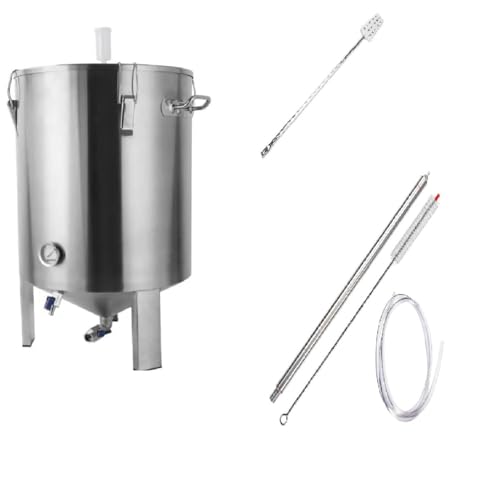
Fermtech 6 Gallon Conical Fermenter
Thirty litre 304 stainless conical supplied with a bottle filler and mash paddle.
Before you do this
Caustic cleaners like PBW clean stainless effectively but burn skin and eyes; wear gloves and eye protection, and never mix a caustic cleaner with an acid sanitiser.
Related on BrewGearCalc
Frequently asked questions
- Does stainless steel make better beer than plastic?
- No. Fermentation quality comes from temperature control, yeast health and sanitation, and both materials hold beer at the same temperature and support the same yeast equally well. Stainless steel's real advantages are durability over years of reuse, resistance to scratching and odor absorption, and the ability to be shaped into a cone with a drain valve. None of that changes how the yeast ferments the wort itself.
- Do plastic fermenting buckets wear out?
- Eventually, yes. Repeated scrubbing over years can leave fine scratches in plastic that are hard to fully sanitise, and enough scratching is a reasonable point to retire a bucket from active use. For most home brewers doing a modest number of batches a year, a quality plastic bucket lasts a long time before that becomes a real concern.
- Is a stainless fermenter worth it over plastic for a beginner?
- Usually not yet. A beginner is still learning temperature control and sanitation, which matter far more to beer quality than vessel material. A plastic bucket ferments a first several batches just as well as stainless, at a fraction of the cost. Consider stainless later, once you know whether the durability, drain valve or odor resistance actually matter for how you brew.
- How much does a full stainless fermenter weigh compared to plastic?
- Stainless vessels generally weigh more empty than plastic ones of similar capacity, since steel is inherently heavier than food grade plastic, and that difference stays once the vessel is full of beer. For anyone who needs to lift and move a full fermenter regularly, the lighter weight of a plastic bucket is a real, practical advantage beyond just price.
- Can stainless fermenters hold onto odors from a previous batch?
- No, stainless steel is non-porous and does not absorb odor or flavor from previous batches the way a scratched plastic vessel potentially can over time. This is one of the genuine long term advantages of stainless, particularly for anyone who ferments strongly flavored beers, like heavily dry hopped styles, in the same vessel repeatedly.
- What is the actual price difference between stainless and plastic fermenters?
- In this catalog, plastic buckets run from roughly $25 to $50, while stainless vessels start around $95 for a straight sided bucket and run past $900 for the largest stainless conicals. Capacity, conical shape and added features like cooling jackets explain most of that spread, not a difference in how well either material ferments beer.
Researched from published brewing formulas, manufacturer specifications and verified owner reviews. This is general guidance, not professional advice.