Guides
How to Balance a Draft Line
A widely used draft-line convention holds that 3/16-inch vinyl beer line creates about 3 psi of resistance per foot, so a keg served at 12 psi commonly needs somewhere around 3 to 4 feet of 3/16-inch line, plus whatever resistance the faucet and any rise add.
The exact resistance per foot varies by tubing brand and inside diameter, which is why a line that pours perfectly in one setup can foam constantly in another built with different tubing.
What line resistance actually is
Resistance in a beer line is friction: as beer moves through a narrow tube, the liquid dragging against the tube's inner wall slows it down, and that drag is what a psi-per-foot figure is actually describing. A narrower tube has proportionally more wall surface relative to the beer moving through it, which is why narrower line creates more resistance per foot than wider line does at the same length. Longer line simply adds more of that same friction, one additional foot at a time.
This is the same basic idea as water resistance in a garden hose: a longer or narrower hose slows the flow more than a short, wide one does, for the same water pressure behind it. A beer line just adds the extra twist that the beer arriving too fast for its dissolved CO2 to stay in solution is what turns into foam, rather than simply a slower stream.
Why 3/16 inch bore became the standard
A 3/16-inch inside diameter line creates enough resistance per foot that a normal home kegerator, with a keg sitting only a short distance from the faucet, can reach a workable line length, commonly a few feet, without needing to coil an impractically long run of tubing into a small space. Wider line like 1/4 inch or 5/16 inch needs considerably more length to create the same resistance, which works fine in a system with more physical room to route line but becomes awkward in a compact kegerator or a tower with a short, direct path to the faucet.
That is the whole reason 3/16-inch line became the default recommendation for typical home setups: it matches the resistance a normal serving pressure calls for within a line length that actually fits inside a standard kegerator, not because it is inherently a better or higher-quality line than the wider alternatives.
What a balanced line actually means
A draft system pours well when the total resistance the beer meets between the keg and the faucet roughly matches the pressure pushing it there. Too little resistance for the pressure, and beer rushes through the line faster than dissolved CO2 can stay in solution, breaking out as foam partway down the line or right at the faucet. Too much resistance, and the pour comes out painfully slow even though the keg itself is perfectly carbonated.
Balancing a line is not about eliminating resistance. It is about matching it to the serving pressure the keg needs to hold its target carbonation level, since that pressure is set by the beer's carbonation target and storage temperature, not by what makes the line pour fastest.
The line resistance convention
Vinyl beer line is widely published, by tubing manufacturers and draft equipment suppliers, as creating a certain amount of resistance per foot depending on its inside diameter, with narrower tubing creating more resistance than wider tubing of the same length. A commonly cited convention puts 3/16-inch line at around 3 psi of resistance per foot, 1/4-inch line at around 0.85 psi per foot, and 5/16-inch line at around 0.4 psi per foot.
These figures are convention values repeated across draft-system guides and supplier charts rather than a single universal specification, and the actual resistance of any specific tubing varies by manufacturer, exact inside diameter and even beer temperature. They are a solid starting point for sizing a line, not a number to treat as exact for every brand of tubing on the market.
| Line inside diameter | Approximate resistance | Basis |
|---|---|---|
| 3/16 inch | about 3 psi per foot | widely published convention, varies by tubing brand |
| 1/4 inch | about 0.85 psi per foot | widely published convention, varies by tubing brand |
| 5/16 inch | about 0.4 psi per foot | widely published convention, varies by tubing brand |
Working through an example
Take a keg served at 12 psi, a common serving pressure for a moderately carbonated ale near typical kegerator temperature. Using the 3/16-inch convention of about 3 psi of resistance per foot, roughly 4 feet of 3/16-inch line accounts for about 12 psi of resistance on its own, close to matching the keg pressure before the faucet and any vertical rise are even factored in.
A faucet and the fittings connecting the line contribute some resistance of their own, and a rise in elevation from the keg up to the tower or tap adds roughly half a pound of resistance per foot of rise, working against gravity. Both are usually small relative to a several-foot run of narrow-bore line, but they are part of the total the line length needs to account for, not something to ignore entirely on a longer draw or a tower with real height to it.
Diagnosing a foamy pour
A pour that foams heavily almost always points to too little total resistance for the pressure the keg is serving at, which usually means the beer line is too short, too wide in diameter, or the serving pressure has been raised without lengthening the line to match. Checking the actual length and diameter of the installed line against the resistance convention for that diameter is the first diagnostic step, before assuming the beer itself is over-carbonated.
A partially warm line is another common, less obvious cause, since foam forms more readily as beer warms even briefly on its way from a cold keg to the faucet. A line that runs through a warm section of a tower or that sits coiled somewhere it picks up ambient heat can foam even when its length and pressure are otherwise well matched.
Diagnosing a slow pour
A pour that comes out slowly, without much foam, usually means too much resistance for the pressure being used, which points to a line that is longer or narrower than it needs to be for the current serving pressure, or a partially restricted faucet or fitting. Coiled beer line kinked tightly in storage, or a faucet with mineral buildup narrowing its internal passage, can both add unintended resistance that has nothing to do with the line's rated length.
Cleaning the line and faucet with a dedicated beer line cleaning kit is worth ruling out before shortening a line that might otherwise be correctly sized, since buildup inside the line changes its effective resistance without changing its labeled length or diameter.
The right order to diagnose a bad pour: temperature, then pressure, then line
Working through the causes of a bad pour in the wrong order wastes time cutting and re-fitting line that was never the actual problem, so it is worth checking the cheapest, fastest variables first. Temperature comes first: confirm the fridge is actually holding a steady reading near the target, since a keg that has drifted warmer than intended both carbonates differently than expected and pours foamier at any given pressure, and this check takes only a thermometer and a couple of minutes.
Pressure comes second: confirm the regulator is actually set to the pressure the target carbonation level and confirmed temperature call for, using a keg carbonation calculator rather than a remembered or guessed number, since a pressure that has drifted or was set incorrectly to begin with will produce a bad pour no matter how well the line is sized. Only once temperature and pressure are both confirmed correct does line length and diameter become the remaining variable worth adjusting, since changing the line first, before ruling out the other two, risks fixing the wrong thing or masking a temperature or pressure problem that will resurface later.
Adjusting a system that will not balance
If a line length calculated from the convention still does not pour cleanly, the fastest fix is usually adjusting serving pressure slightly within the range the target carbonation level and temperature allow, rather than repeatedly cutting and re-fitting line to chase an exact match. A keg carbonation calculator that confirms the correct pressure range for the target carbonation and temperature gives a boundary to work within, so pressure adjustments stay within what still delivers the intended carbonation rather than drifting away from it to fix a pour.
Swapping to a wider or narrower diameter line changes the resistance per foot dramatically compared with adjusting length alone, so moving from 3/16-inch to 1/4-inch line, for example, is often a more practical fix for a stubbornly foamy short run than trying to add several more feet of narrow tubing into a tight kegerator space.
Everything else worth considering

Ferroday 5 ft Ball Lock Beer Line with Picnic Tap
Assembled liquid line with a ball lock disconnect and a picnic tap, which is all you need to pour before a tower exists.
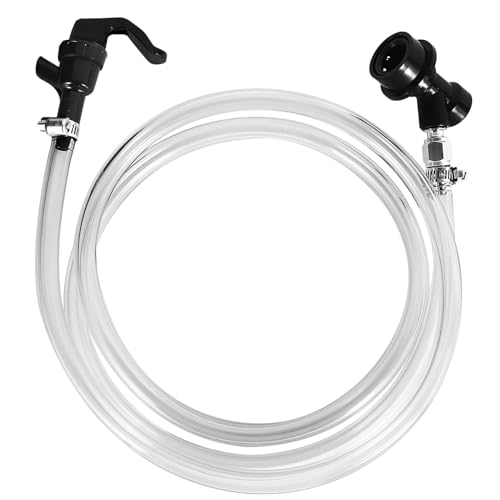
MRbrew 5 ft Ball Lock Beer Line Kit (3/16 inch)
Three sixteenths inch beer hose and picnic tap assembly, the bore that gives correct pour resistance.
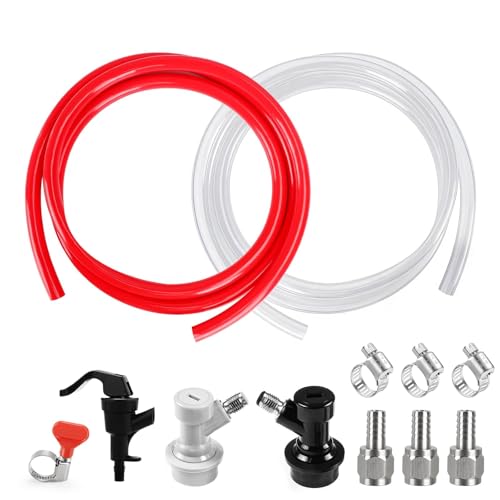
Ball Lock Beer Line and CO2 Gas Line Kit (5 ft each)
Matched liquid and gas line assemblies, which is what a single keg actually needs.

Perlick 630SS Stainless Draft Faucet
Forward sealing stainless faucet that does not stick shut between pours the way a rear sealing faucet can.
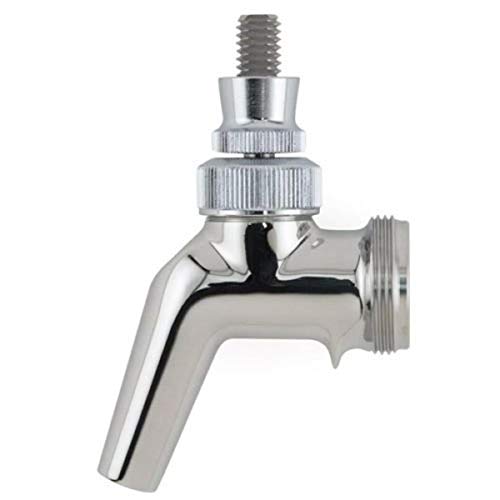
Perlick 630PC Draft Faucet (chrome plated)
The chrome plated version of the forward sealing Perlick, cheaper than stainless.

Kegland NukaTap Forward Sealing Faucet
Forward sealing faucet with a stainless spout, a common Perlick alternative.
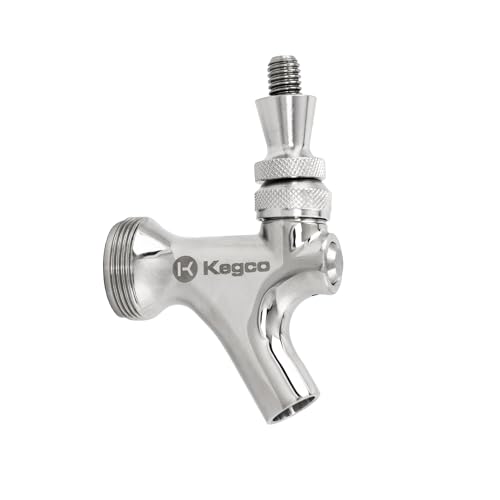
Kegco Standard Stainless Beer Faucet
Standard rear sealing stainless faucet, the usual replacement for a worn chrome tap.

SPARC Gen2 Premium CO2 Regulator
Single output CO2 keg regulator with a CGA-320 inlet.
Before you do this
CO2 cylinders supplying a draft system are high pressure vessels: keep the tank secured upright, never modify the valve or regulator, and have refills done only by a qualified gas supplier. Check every line and faucet connection with a soapy water test after any change to the system before leaving it unattended.
Related on BrewGearCalc
- Force carbonating a keg
- Kegging for beginners
- Keg carbonation calculator
- Keg carbonation reference
- All brewing guides
Frequently asked questions
- How long should my beer line be?
- It depends on your serving pressure and the line's inside diameter, since narrower line creates more resistance per foot. As a starting point using the widely cited convention of about 3 psi per foot for 3/16-inch line, a keg served at 12 psi commonly needs somewhere around 3 to 4 feet of that line, plus a bit more to account for the faucet and any rise. The exact figure varies by tubing brand, so treat this as a starting point to fine-tune, not an exact answer.
- Why does my beer foam every time I pour it?
- Heavy foaming almost always means too little total resistance for the serving pressure, usually from a beer line that is too short or too wide in diameter for the pressure being used. Check the actual installed line length and diameter against the resistance convention for that diameter before assuming the beer itself is over-carbonated. A warm section of line picking up heat on its way to the faucet is another common contributor worth ruling out.
- Is 3/16-inch or 1/4-inch line better for kegging?
- Neither is universally better; they need different lengths to balance the same serving pressure, since 3/16-inch line creates roughly 3 psi of resistance per foot by common convention, versus roughly 0.85 psi per foot for 1/4-inch line. A shorter run of 3/16-inch line balances the same pressure as a much longer run of 1/4-inch line, which is why 3/16-inch is common in compact kegerator setups with limited room to coil line.
- Does the height of my tower or tap affect line balance?
- Yes, though usually less than the line length itself. Beer being pushed upward against gravity meets roughly half a pound of resistance per foot of rise, which adds to the total the beer line needs to account for. On a tall tower or a draw with real elevation change, that added resistance is worth factoring in alongside the line length convention, rather than sizing the line purely on distance.
- My keg pours fine one day and foams the next. What changed?
- Since carbonation and resistance both respond to temperature, a fridge that is not holding a steady temperature, or a line that briefly warms in a section near a compressor or outside a insulated tower, can shift a system that is normally balanced into foaming without anything about the line or pressure setting actually changing. Checking that the fridge temperature is stable is a reasonable first step before adjusting the line or pressure.
- Can I fix a foamy pour by just lowering the serving pressure?
- Only within a limited range, since serving pressure is tied to the beer's target carbonation level and temperature, not just how the line pours. Lowering pressure below what the target carbonation and temperature call for will slowly pull dissolved CO2 back out of the beer over time rather than fixing the underlying line balance. A keg carbonation calculator can confirm how much room there actually is to adjust pressure before the carbonation level itself starts to drift.
Researched from published brewing formulas, manufacturer specifications and verified owner reviews. This is general guidance, not professional advice.