Guides
Force Carbonating a Keg
Force carbonating a keg at around 10 to 12 psi near 38°F, a pressure and temperature combination that lands close to 2.4 volumes of CO2, commonly takes about 1 to 2 weeks left undisturbed at serving pressure, a widely repeated home-brewing convention rather than a fixed law.
Shaking or rocking a keg pressurized above serving pressure speeds that same process up to as little as 24 to 48 hours, though the actual time still depends on temperature and how vigorously the keg is agitated.
What force carbonating actually does
Force carbonating dissolves CO2 into cold beer by holding the keg under gas pressure, letting the beer absorb CO2 through the surface exposed in the headspace until it reaches equilibrium with the pressure and temperature it is sitting at. This is the same underlying physics as any carbonated beverage: cold liquid under pressure holds more dissolved gas than warm liquid at the same pressure, which is why temperature and pressure have to be set together, not independently.
That linkage is the core thing to understand before force carbonating anything. Setting a pressure without accounting for the keg's temperature, or changing the fridge temperature without adjusting pressure to match, will carbonate the beer to a level that does not match what was actually intended.
Why pressure and temperature are set together
A given carbonation level, measured in volumes of CO2, corresponds to a specific pressure at a specific temperature, and that relationship changes at every different temperature. Roughly 10 to 12 psi holds about 2.4 volumes of CO2 near 38°F, a commonly cited reference point for a moderately carbonated ale-strength beer stored at typical kegerator temperature, but the same 10 to 12 psi at a warmer fridge temperature would carbonate the beer less, since warmer liquid holds less dissolved gas at the same pressure.
Rather than memorizing pressure and temperature pairs for every target carbonation level, a keg carbonation calculator that takes your target volumes and actual storage temperature returns the correct serving pressure directly, since the relationship is a real physical curve, not a simple lookup that works the same everywhere.
The set-and-forget method
The simplest approach is connecting the keg to CO2 at the serving pressure calculated for the target carbonation level and temperature, then leaving it alone. CO2 diffuses into the beer through the headspace surface at the top of the keg, and given enough time at a constant pressure and temperature, the beer reaches the same equilibrium it would reach through any other carbonation method.
The tradeoff is time. Diffusion through a relatively small headspace surface is a slow process, and this method commonly takes about 1 to 2 weeks to fully carbonate a keg, a home-brewing convention based on repeated experience rather than a fixed physical law, since the real time depends on the keg's headspace volume, temperature and how much agitation the keg happens to get from being moved.
| Method | How it works | Convention timeframe |
|---|---|---|
| Set-and-forget at serving pressure | The keg sits at target pressure and temperature until CO2 diffuses in through the headspace | commonly about 1 to 2 weeks, a widely repeated convention |
| Shake or rock method | The keg is pressurized above target and shaken or rocked to force gas into solution faster, then reset to serving pressure | commonly as little as 24 to 48 hours, more variable results |
The shake or rock method
Shaking or rocking a keg while it is pressurized above the eventual serving pressure speeds carbonation up considerably, since physically agitating the beer exposes far more surface area to the CO2 above it than sitting still ever would, closer to how a soda fountain or a carbonating stone forces gas into solution quickly. A common version of this method involves pressurizing the keg to somewhere above the final target, laying it on its side, and rocking or rolling it for several minutes to tens of minutes before checking progress and repeating as needed.
This method gets a keg drinkable much faster than the set-and-forget approach, but it is harder to hit a precise carbonation level with, since how much CO2 actually dissolves depends on how vigorously and how long the keg was agitated, a much less controlled variable than simply waiting at a fixed pressure. Many brewers use the shake method to get a keg to a rough starting point quickly, then let it sit at the correct serving pressure for a day or two afterward to settle in at the intended level.
Confirming carbonation before serving
Pouring a test glass is the simplest check, but a glass poured through an unbalanced line or straight after shaking can look over- or under-carbonated even when the keg itself is close to correct, since foam behavior depends on the line and faucet setup as much as the beer's actual dissolved CO2. Letting the keg rest undisturbed at serving pressure and temperature for a day before judging the result gives a more accurate read.
A keg that still tastes flat after the expected timeframe is more often explained by a leak somewhere in the gas line or a lid seal than by the carbonation method itself, so checking connections with a soapy water test is worth doing before assuming the beer simply needs more time.
Why overshooting is far slower to fix than to cause
Pushing a keg to a higher pressure or agitating it harder adds dissolved CO2 quickly, since forcing gas into solution is an active process that responds fast to more pressure or more surface agitation. Pulling dissolved CO2 back out is the opposite: it is a slow, passive process that relies on venting pressure and letting the beer gradually release gas until it reaches equilibrium with the lower pressure, which happens over days, not minutes. That asymmetry is the main reason overshooting a target carbonation level is a much more time-consuming mistake to correct than undershooting it.
Undercarbonating, by contrast, is simple to fix in either direction: leave the keg connected longer, raise the pressure slightly, or use the shake method to catch it up. Overcarbonating has no equivalent shortcut, which is a real argument for approaching a target carbonation level from below, checking progress along the way, rather than intentionally overshooting and planning to dial it back later.
Telling whether a keg has overshot its target
A keg poured after resting undisturbed at serving pressure and temperature that still produces excessive foam on a properly balanced line, one sized correctly for that serving pressure, is the clearest sign of true overcarbonation rather than a line or temperature problem. Ruling out the line and the fridge temperature first matters, since both of those can produce foam that looks identical to overcarbonation without the beer actually holding excess CO2.
A flat, quick vent test can help confirm it: briefly opening the pressure relief valve on the keg lid and listening to how long and how forcefully gas escapes gives a rough read on how much CO2 pressure has built up relative to what the serving pressure alone would suggest, though it is a qualitative check rather than a precise measurement of dissolved volumes.
Correcting a keg that is already overcarbonated
The standard fix is disconnecting the CO2, venting the keg's pressure relief valve to drop it to zero, and leaving it disconnected from gas, or connected at a much lower holding pressure, for a day or two before checking again. Venting fully once is rarely enough on its own, since the beer still holds dissolved CO2 above the new lower pressure and needs time to release some of it back out through the headspace, the same slow diffusion process that carbonated it in the first place, just running in reverse.
Repeating that vent-and-wait cycle, checking a test pour after each rest period, brings an overcarbonated keg back down gradually rather than all at once. It takes patience, generally longer than it took to overshoot in the first place, which is exactly the asymmetry that makes careful, incremental carbonation from the start the easier path.
Common mistakes with force carbonating
A handful of habits account for most force carbonation problems.
- Setting a pressure without matching it to the keg's actual temperature, rather than using a calculator that ties the two together
- Changing the fridge temperature after the keg is already carbonated, which shifts the equilibrium without a matching pressure adjustment
- Judging carbonation from the first pour off a freshly shaken or freshly connected keg, before it has had time to settle
- Assuming a flat-tasting keg needs more time when a leaking connection is quietly bleeding pressure instead
Everything else worth considering

SPARC Gen2 Premium CO2 Regulator
Single output CO2 keg regulator with a CGA-320 inlet.

WELLBOM Dual Output CO2 Regulator (CGA-320)
Two output draft regulator with independent gauges.

Ferroday 0 to 120 PSI Dual Gauge CO2 Regulator
Higher range dual gauge regulator, useful when burst carbonating.

TMCRAFT 5 lb CO2 Tank (DOT aluminum, CGA-320)
Five pound DOT aluminium cylinder with a CGA-320 valve, supplied empty.

GANCOWISE 5 lb Aluminum CO2 Tank (DOT, CGA320)
DOT approved five pound aluminium CO2 cylinder with a CGA320 valve. Ships empty and is filled locally.

TMCRAFT 5 Gallon Ball Lock Corny Keg
New stainless ball lock keg with dual rubber handles, the standard homebrew serving vessel.
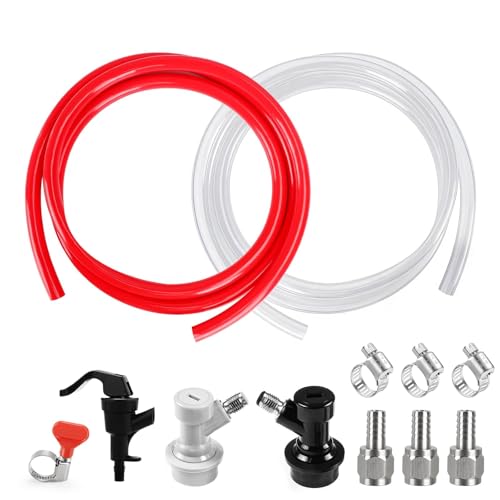
Ball Lock Beer Line and CO2 Gas Line Kit (5 ft each)
Matched liquid and gas line assemblies, which is what a single keg actually needs.
Before you do this
CO2 cylinders are high pressure vessels: keep the tank secured upright at all times, never attempt to modify a valve or regulator, and have tanks refilled only by a qualified gas supplier. Always check that a keg holds pressure with a soapy water test on every connection before storing it away for the length of a carbonation cycle.
Related on BrewGearCalc
- Keg carbonation calculator
- Keg carbonation reference
- Kegging for beginners
- How to balance a draft line
- A practical guide to priming sugar
Frequently asked questions
- What pressure should I use to force carbonate my keg?
- It depends on both your target carbonation level and the keg's actual storage temperature, since the two are linked. A commonly cited reference point is roughly 10 to 12 psi near 38°F for about 2.4 volumes of CO2, a typical ale-strength target, but a different temperature needs a different pressure for the same result. A keg carbonation calculator that takes your target volumes and actual temperature gives the correct number rather than relying on one flat setting.
- How long does force carbonating take?
- Left at serving pressure and temperature without agitation, full carbonation commonly takes about 1 to 2 weeks, a widely repeated home-brewing convention rather than a fixed rule, since real time depends on headspace volume, temperature and incidental movement. Shaking or rocking the keg while pressurized above target speeds this up considerably, sometimes to as little as 24 to 48 hours, at the cost of less precise control over the final carbonation level.
- Is the shake method as accurate as waiting at serving pressure?
- Not as precisely. Shaking forces gas into solution quickly by exposing more surface area to the CO2, but how much actually dissolves depends on how vigorously and how long the keg was agitated, which is harder to control than simply holding a fixed pressure over time. Many brewers use shaking to get a keg to a rough drinkable level quickly, then let it sit at the correct serving pressure for a day or two afterward to settle at the intended target.
- Why is my keg still flat after two weeks?
- A keg that has not carbonated after the expected timeframe is more often explained by a leak in the gas line, a bad lid seal or a loose fitting quietly bleeding pressure than by the carbonation method itself. Checking every connection with a soapy water test, which bubbles visibly at a leak, is worth doing before assuming the beer simply needs more time or more pressure.
- Can I force carbonate at room temperature?
- Beer can absorb CO2 at any temperature, but warmer liquid holds less dissolved gas at a given pressure than colder liquid does, so reaching the same carbonation level at room temperature needs a higher pressure than the same target near typical kegerator temperature. Most home setups carbonate cold specifically because it reaches the target level at a lower, more comfortable serving pressure.
- Does changing my fridge temperature affect a keg that is already carbonated?
- Yes. Carbonation is an equilibrium between pressure and temperature, so raising the fridge temperature after a keg has settled at a given pressure will eventually push some dissolved CO2 back out of solution, and lowering the temperature can pull additional CO2 in if pressure stays the same. Adjusting serving pressure to match a new storage temperature keeps the carbonation level where it was set.
Researched from published brewing formulas, manufacturer specifications and verified owner reviews. This is general guidance, not professional advice.