Reviews
Tilt Wireless Hydrometer Review
The Tilt Wireless Hydrometer and Thermometer (tilt-black) is a $135.00 floating sensor that reports gravity and temperature to a phone app without opening the fermenter, suited to a brewer who already checks gravity often enough that avoiding oxygen exposure on every reading matters.

Tilt Wireless Hydrometer and Thermometer
Tilt
It reports gravity and temperature continuously through a sealed fermenter lid, the one thing a $14.99 glass hydrometer can never do without opening the vessel and letting oxygen in.
Price last checked at publication and changes often.
What this review is and what it is not
This is not the result of personal hands-on testing, and nobody on this site owns a Tilt Wireless Hydrometer. This review is built from the published product specification, the listing details for this exact model, and the pattern found across verified owner reviews of Tilt units over time, and it says so directly rather than implying a lab process that did not happen.
That approach cannot tell you how the Bluetooth signal performs through your specific fermenter material or how far it reaches to your specific phone; those are conditions owner reviews describe inconsistently because they depend on the individual setup. Where the published listing does not give a figure a buyer would want, that gap is stated rather than filled with a guess.
What a wireless hydrometer actually does
A standard glass hydrometer requires pulling a sample out of the fermenter into a test jar, which means opening the vessel and exposing the beer to oxygen every single time you want a reading. The Tilt is a sealed, floating sensor that sits inside a closed fermenter and transmits specific gravity and temperature by Bluetooth to a phone app continuously, without ever opening the lid. That is the entire value proposition at $135.00: fewer openings, less oxygen pickup, and a gravity trend over days instead of a single point-in-time number.
Reducing how often a fermenter is opened is a genuine, well-documented way to limit oxidation in finished beer, which shows up as cardboard or wet-paper off-flavors developing over storage time. A device that lets you track fermentation progress without opening the vessel supports that goal directly, which is the accuracy point that makes the Tilt worth its price for the right brewer.
Specifications and what they mean
At roughly nine times the cost of a basic glass hydrometer kit, the Tilt is not a replacement purchase for a beginner's first fermentation; it is a convenience and precision upgrade for someone who already understands what a gravity reading means and wants it more often without the oxygen cost of getting it.
| Tool | Kind | Opens the fermenter? | Price |
|---|---|---|---|
| Tilt Wireless Hydrometer and Thermometer | Wireless logger | No | $135.00 |
| Fermtech Glass Triple Scale Hydrometer Kit | Glass hydrometer | Yes | $14.99 |
| Brewer's Elite Hydrometer and Test Jar | Glass hydrometer | Yes | $21.99 |
Calibration drift and the case for keeping a glass hydrometer anyway
Verified owner reviews consistently raise calibration drift as the real ownership issue with wireless hydrometers as a category, not unique to Tilt specifically: floating sensors can read slightly off from a true gravity value over time or after being moved between different beers, and that drift is not always obvious from the app alone. The practical fix owners report is checking a Tilt reading against a glass hydrometer sample periodically, particularly at the start of a batch and again near what looks like final gravity, rather than trusting the wireless number in isolation for every batch.
That is also why this review does not recommend retiring your glass hydrometer even if you buy a Tilt. A glass hydrometer such as the Fermtech Glass Triple Scale Hydrometer Kit (fermtech-hydro) at $14.99 remains the ground truth check, and the two tools are complementary rather than one replacing the other.
Battery life and the other ownership cost
The Tilt runs on an internal battery that is not swapped like a standard AA cell in most versions of this device, and owner reviews describe battery life as a real, recurring consideration rather than a one-time setup detail. Battery replacement or service, when needed, is a cost and a step this review will not put a number on since the published listing does not specify one; check the current listing and manufacturer support page for the specific process and expected interval before buying if that matters to your decision.
- A Tilt is typically used for one fermenter at a time unless you own multiple units, since it lives inside the vessel for the length of the batch.
- The companion smartphone app is how most owners read gravity trends over time; check that the app is supported on your phone's operating system before buying.
Who should buy this, and who should not
Buy the Tilt if you already brew often enough that opening a fermenter for every gravity check meaningfully adds up in oxidation risk, and if you want a gravity trend across days rather than single readings. It is a strong fit alongside pressure fermentation or any closed-transfer setup, since both are built around minimizing how often the vessel is opened. Skip it for a first few batches: a $14.99 to $21.99 glass hydrometer teaches the fundamentals of reading gravity for a fraction of the price, and that skill is worth having even after a Tilt is in the kit.
Fitting a Tilt into a closed-transfer workflow
The Tilt's biggest practical advantage shows up once it is paired with a sealed vessel, particularly a pressure fermenter built around closed transfers. Reading gravity through a sealed lid without opening it at all matches exactly the same goal a pressure fermenter is built around: keeping the beer from ever meeting open air until it reaches a purged keg. Used together, the two pieces of equipment reinforce the same low-oxygen approach rather than solving two separate problems.
For a brewer still fermenting in an open bucket with a simple airlock, the Tilt still removes the need to crack the lid for a reading, which matters, but the oxidation benefit compounds further once the whole downstream process, from fermenter to keg, is built around minimizing air exposure at every step rather than just at the gravity check.
One Tilt per fermenter, and the app it depends on
Because the sensor lives inside the fermenter for the full length of a batch, a single Tilt effectively dedicates itself to one fermentation at a time unless a brewer owns more than one unit for multiple simultaneous batches. Anyone running several fermenters at once should budget for that before assuming one Tilt covers the whole lineup. The device is also dependent on its companion smartphone app to actually display gravity and temperature trends, so confirm that app is currently supported on your phone's operating system before buying, since app support and features can change over time in ways a hardware review cannot predict.
What happens when a reading drifts and nobody notices
The specific risk with any continuous logging device is not that it fails loudly, it is that it can drift quietly. A gradually inaccurate gravity reading does not stop the app from displaying a number, it just displays the wrong one, and a brewer who trusts that number without a periodic glass hydrometer check has no obvious signal that anything is off until a finished beer tastes different than expected. That is why treating a Tilt as a continuous trend tool rather than a single source of absolute truth matters: the shape of the gravity curve over days, steadily dropping and then flattening, is more reliable information than any single reading taken in isolation.
The practical habit that avoids this problem is straightforward: take a glass hydrometer reading at the start of a batch and compare it against what the Tilt reports at the same point, then do the same comparison again once the Tilt shows gravity has flattened near what looks like final gravity. Two points of agreement, at the start and near the end, catch most of the drift that would otherwise go unnoticed for an entire batch.
The three tiers
These are three genuinely different builds, not the same product at three prices. Buy the tier that matches how much you already know you will use it.
Fermtech Glass Triple Scale Hydrometer Kit
Fermtech
A glass hydrometer kit for $14.99 teaches you to read specific gravity directly, the skill worth having before adding a wireless device on top of it.
$14.99
View on AmazonBrewer's Elite Hydrometer and Test Jar
Brewer's Elite
A hydrometer and test jar together for $21.99 is a small step up in build quality over the cheapest glass kits, still requiring you to pull a sample each time you check gravity.
$21.99
View on AmazonTilt Pro Mini Wireless Hydrometer
Tilt
The Tilt Pro Mini costs $175.00, a step up from the standard Tilt reviewed here. Skip it unless you specifically need the features that differentiate the Pro Mini from the base model, since the core wireless, no-open reading is the same idea at a lower price on the standard Tilt.
$175.00
View on AmazonEverything else worth considering
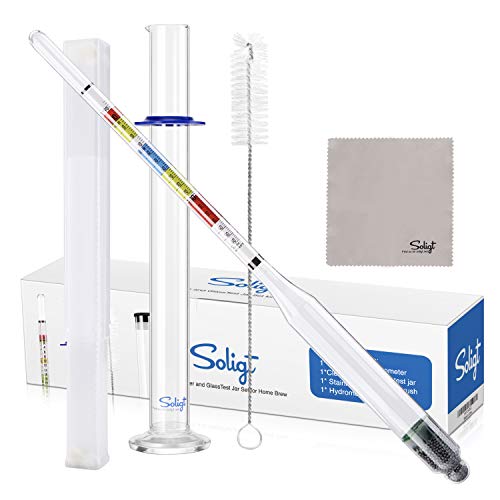
SOLIGT Triple Scale Hydrometer with Glass Test Jar
Hydrometer reading ABV, Brix and specific gravity, supplied with a glass jar.

Fermentaholics Hydrometer Test Jar
Measuring cylinder for taking a gravity sample without dropping the hydrometer into the fermenter.

Brewing America Glass Hydrometer Test Jar with Brush
Narrow glass flask and cleaning brush, which reads more accurately than a wide vessel.

Tilt Pico WiFi Adapter
Bluetooth to WiFi bridge that logs a Tilt to the cloud without leaving a phone beside the fermenter.

Ade Advanced Optics Beer Wort Refractometer
Dual scale refractometer reading specific gravity 1.000 to 1.120 and Brix, built for wort rather than fruit.
Before you do this
A hydrometer, wireless or glass, showing stable gravity across several consecutive days is the only real check that fermentation has actually finished. Bottling before that point, or over-priming at packaging, is how bottle bombs happen.
Related on BrewGearCalc
- Best hydrometers
- Tilt vs hydrometer
- Hydrometer vs refractometer
- How to read a hydrometer
- Hydrometer correction calculator
- Best pressure fermenters
Frequently asked questions
- Is the Tilt Hydrometer accurate?
- Verified owner reviews describe the Tilt as generally reliable but subject to calibration drift over time and between uses, which is a known characteristic of floating wireless sensors as a category, not a defect unique to this product. The practical fix owners report is periodically checking a Tilt reading against a glass hydrometer sample, especially near what looks like final gravity, rather than trusting the wireless number alone for every batch.
- Do I still need a glass hydrometer if I buy a Tilt?
- Yes. A glass hydrometer such as the Fermtech Glass Triple Scale Hydrometer Kit at $14.99 is the ground truth check against calibration drift in a wireless sensor, and the two tools work best together rather than one replacing the other. Most experienced owners keep both: the Tilt for continuous tracking without opening the fermenter, and a glass hydrometer for periodic verification.
- How does the Tilt Hydrometer avoid oxidizing my beer?
- The Tilt is a sealed, floating sensor that sits inside a closed fermenter and transmits gravity and temperature by Bluetooth, so it never requires opening the vessel to take a reading. A standard glass hydrometer requires pulling a sample out into a test jar every time, which exposes the beer to oxygen with each check. Fewer fermenter openings is a well-documented way to reduce the risk of oxidation-related off-flavors developing later.
- How long does the Tilt Hydrometer battery last?
- The published listing does not specify an exact battery life figure, and this review will not invent one. Verified owner reviews describe battery life as a real, ongoing ownership consideration rather than a one-time detail, since the battery in most versions is internal rather than a swappable standard cell. Check the current manufacturer listing and support page for the specific expected interval before buying if this matters to you.
- Is the Tilt Hydrometer worth it for a first batch?
- Probably not. At $135.00, it costs roughly nine times a basic glass hydrometer kit, and a first-time brewer benefits more from learning to read a glass hydrometer directly than from a wireless convenience upgrade. The Tilt earns its price once you are brewing often enough that reducing fermenter openings across many batches, or running a pressure fermenter built around closed transfers, makes the oxygen savings add up.
- Can stable Tilt readings tell me fermentation is finished?
- Stable gravity readings across several consecutive days, not a single reading, are the real check that fermentation has finished, whether the readings come from a Tilt or a glass hydrometer. Bottling or transferring based on one favorable-looking number is a common cause of bottle bombs if fermentation has not actually completed. Confirm the trend has flattened before packaging, and cross-check with a glass hydrometer if a Tilt reading looks unusual.
Researched from published brewing formulas, manufacturer specifications and verified owner reviews. This is general guidance, not professional advice.